Drying Yarrow: Urban Farmer Method

What practitioner of magic does not desire to live out in the country with plenty of land to plant magical herbs and a forest nearby where we can go wildcrafting? Yet, I have the suspicion that many of us are city dwellers who often practice our magic indoors and have little or no land at our disposal. This does not mean we cannot connect with our Earth Mother in meaningful ways.

yarrow01
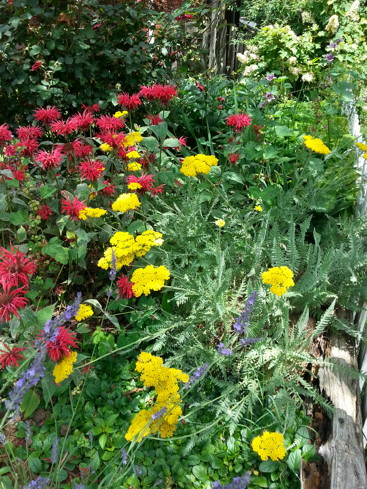
Yarrow and bee balm in the corner of my yard.

The front yard of my house is the only place that gets enough sunlight to grow things besides ferns and other shade plants. It’s very small but I grow a number of medicinal herbs and bee friendly flowers. If you have no yard whatsoever, you can also plant many of these plants in container gardens.

Yarrow is one of my favorites, no only because it has a long bloom season, it also dries easily and is one of my go-to plants for magic spells. Yarrow is also a perennial so it keeps coming back and multiplying year after year. I only harvest what I need and never gather more than 1/4 of the stems that germinate and grow. It’s amazing how much dried yarrow a few stems produces so harvest it cautiously.

Drying yarrow by the “urban farming” method is easy! First cut the flowers off the stem by pushing your kitchen shears as close to the bud as you can get them.

yarrow02

Take all the leaves off the stems as well. Return the stems to the earth for composting.

yarrow03
yarrow04

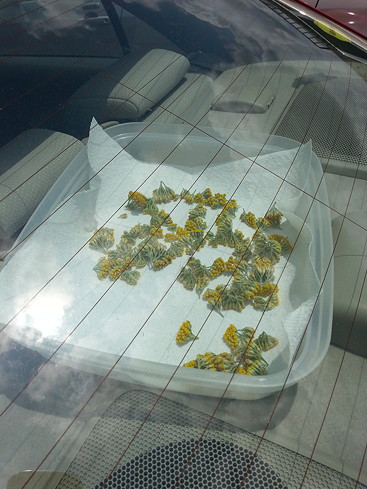
Next, place the buds and leaves (I do them separately) in a large plastic or metal container that is lined with a paper towel. Place the container in the rear window of your car and keep it there until the buds and stems are dry which only takes a few days.

yarrow05
yarrow06

Another method is to place them on a brown paper bag from the grocery store instead of a plastic oe metal container. Who needs an expensive dehydrator? This does the job quickly and inexpensively!

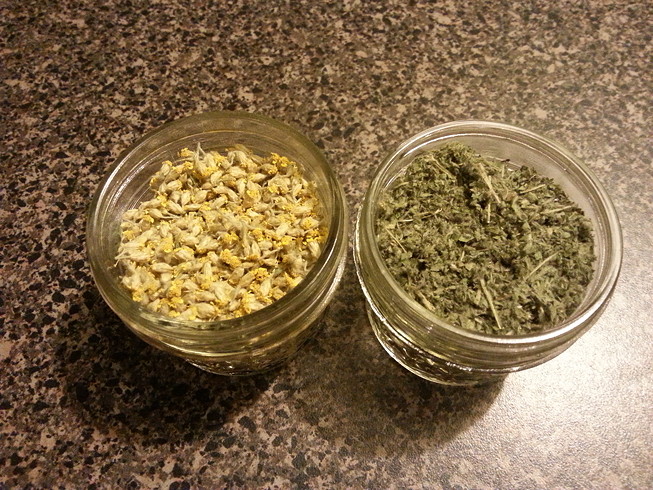
The finished product is gorgeous. When the buds are dried they can be easily separated into individual pieces. The leaves can either be crumbled by hand or placed in a food processor until they reach the desired consistency. I use this method of drying for most of my herbs and it’s as easy as it gets! Give it a try!

Copyright ©2023 by David Taliesin, http://www.sabbatsandsabbaths.com

Posted in Herbology | Tagged , , , , , | 1 Comment

Walpurgisnacht Fire Ritual

Here is the ritual we did at this month’s Welcoming Circle. Feel free to use/adapt for your own celebration of Walpurgisnacht on April 30.

FIRE EMPOWERMENT RITUAL FOR WALPURGISNACHT

CASTING THE CIRCLE—David Taliesin

On Walpurgisnacht, bonfires burn brightly,
their flames kindle our imagination
and remind us of the creative spark each of us possesses.

Like it’s calendar opposite Samhain,
Walpurgisnacht is a time
when the veil between the worlds is thin.

This allows us easy access
to the voices of our ancestors
who have much wisdom to share
as we face the tumultuous times we live in.

May our ritual tonight fan the embers of creativity
as we shake off the slumber of winter
and enter into a time of growth and rebirth.

May the Ancestors whisper into our ears
all we need to know in order to prosper
and bring about positive change
in our lives and in our world.
So mote it be!

With this incense, we form a protective circle
that will shield us from any negative forces
who seek to hinder the sacred work
we are about to begin.

[Leader goes around the circle, fanning a protective incense such as frankincense or other solar/fire related incense. If you are doing this ritual outside around a bonfire, make sure the smoke reaches everyone in the circle.]

CALLING THE QUARTERS—David Taliesin

Guardians and Ancestors of the East, Spirits of Air,
May our ears be attuned to any messages
You have to give us tonight.
May Heidh, the mistress of magic, weave a web
of creative energy all around us!
Hail and welcome!

Guardians and Ancestors of the South, Spirits of Fire,
Light the way for us in these uncertain times.
May Wodan, the master of magic,
light a fire in our hearts
that will move us from apathy to action.
Hail and welcome!

Guardians and Ancestors of the West, Spirits of Water,
Revive our weary souls with your hope,
peace, compassion and empathy.
Wash away any feelings of pessimism and despair
we carry with us tonight.
Hail and welcome!

Guardians and Ancestors of the North, Spirits of Earth,
may the greening of spring rub off on us,
helping us to grow in ways that enable us
to reach our fullest potential!
Hail and welcome!

Great Spirit, who works in our midst
in ways both seen and unseen,
we ask you to bless our ritual tonight.
We are honored by your presence,
And treasure your wisdom.
Hail and welcome!

FIRE EMPOWERMENT SPELL—David Taliesin

Strips of paper, pen
Caudron
Red or white candle
Yarrow
Dragon’s Blood or Rue Oil

Light the candle and anoint it with the Dragon’s Blood or Rue Oil. Place it in the cauldron. Sprinkle a pinch of yarrow in its flames as a symbol of courage. Write on strips of paper the things that are currently keeping you from reaching your fullest potential. Then, one by one, place each strip in the flame and let it burn as you verbally state the opposite of what’s on the paper, i.e. what you would like to see come into your life. Let it burn out in the cauldron. Ex. If you write “feeling overwhelmed” on the paper, say something like “I will be calm and peaceful.”

[If you are doing this outside with a bonfire, sprinkle the yarrow into its flames and, one by one, throw your pieces of paper into the bonfire.]

BLESSING FOR SETTING INTENTIONS—David Taliesin

Heidh and Wodan, mistress and master of magic,
we’ve set fire to the roadblocks
that are preventing us from moving forward,
and stated our intentions for the future.
Bless and empower our work tonight.
Guide us in the days ahead that we might
change the world for the better!
So mote it be!

CLOSING THE CIRCLE—David Taliesin

Guardians and Ancestors of the North, Spirits of Earth,
We thank you for your presence in our circle tonight.
May your stability and strength travel with us
As we leave this place.
Stay if you will. go if you must!
We bid you farewell!

Guardians and Ancestors of the West, Spirits of Water,
We thank you for your presence in our circle tonight.
May your compassion and peace travel with us
As we leave this place.
Stay if you will, go if you must.
We bid you farewell!

Guardians and Ancestors of the South, Spirits of Fire,
We thank you for your presence in our circle tonight.
May your guidance and clarity travel with us
As we leave this place.
Stay if you will, go if you must.
We bid you farewell!

Guardians and Ancestors of the East, Spirits of Air,
We thank you for your presence in our circle tonight.
May your wisdom and insight travel with us
As we leave this place.
Stay if you will, go if you must.
We bid you farewell!

Great Spirit, who is known to us by many names.
We thank you for your presence in our circle tonight.
Stay if you will, go if you must.
We bid you farewell!

The circle is open but never unbroken
Because it is a circle woven in love.
Whatever energy is left in this space
We return to the earth with a spirit of gratitude.
Merry meet and merry part, and merry meet again.

Copyright ©2023 by David Taliesin, http://www.sabbatsandsabbaths.com

Posted in Beltane | Tagged , , , | Leave a comment

Stories of Giants: Jöntar and Nephilim

Perhaps the most well-known giants, thanks to Marvel’s Thor movies, are those mentioned in Norse Mythology. The Jöntar inhabit one of the Nine Worlds known as Jötunheimr. There are numerous stories about them that are easy to find. But did you know that there are giants mentioned in the Torah? Yep, that’s what I said. These giants are known as Nephilim. The first place we encounter them is Genesis 6:1-4:

“When people began to multiply on the face of the ground, and daughters were born to them, the sons of God saw that they were fair, and they took wives for themselves of all that they chose. Then the Lord said, ‘My spirit shall not abide in mortals forever, for they are flesh; their days shall be one hundred twenty years.’ The Nephilim were on the earth in those days—and also afterward—when the sons of God went in to the daughters of humans, who bore children to them. These were the heroes that were of old, warriors of renown. [NRSVUE]

You can also find references to them in Numbers 13:33 and Ezekiel 32 as well as the Deuterocanonical books Judith 16:6, Sirach 16: I 7, Baruch 3:26-28 and Wisdom 14:6.

The fascinating thing to me regarding the Nephilim is that they are the offspring of the “sons of God” (i.e. gods, divine beings) and human women. So much for monotheism in the Torah! (But that’s a subject for another time!) Perhaps these stories have more in common with their Norse counterparts than we might think they do. They are some of the oldest stories in the Bible, and commentators will do back flips and triple summersaults in order to explain them away!

Since this subject matter is definitely not my area of expertise I often rely on Rabbi Richard Elliott Freidman’s Commentary on the Torah. His scholarship is impeccable and I have turned to him on more than one occasion when preparing sermons based on the Torah texts.

Here are some of his thoughts on the Nephilim: “The issue is that there are giants: uncommonly big, powerful persons, who are frightening. The first question is: from where did they come? Answer: bene elohim have relations with human women, and they give birth to giants, Nephilim. Whatever the biblical author thought bene elohim were, we can say at a minimum that it refers here to some sort of (male) creatures from the divine realm. As in an extremely common mythological theme, such mixed divine-human breeding produces beings who are bigger and stronger than regular humans.”

Later he writes, “This does not come up again in the story until thousands of years later. When Moses sends men to scout the promise land, they see giants: the Nephilim (Num 13:33). This is what scares the south, and their fear infects the Israelites, changing the destiny of the wilderness generation. A generation later, Joshua eliminates all the giants except from the Philistine cities, particularly the city of Gath (Josh 11:21-22). and later still, the most famous Philistine giant, Goliath, comes from Gath (1 Sam 17:4). and David defeats him.”

I share this information with you because I thought it was an interesting connection between spiritual paths that we might not think share anything in common. But as readers of my blog know, I see these connections all the time which reminds us of our spiritual ties to one another. Maybe it will help us to be a little less hostile toward one another.

Copyright ©2023 by David Taliesin, http://www.sabbatsandsabbaths.com

Posted in Norse/Germanic Spirituality | Tagged , , , , , | Leave a comment

The Easter Witch?

tumblr_m22kxgkmT91qcmqg5

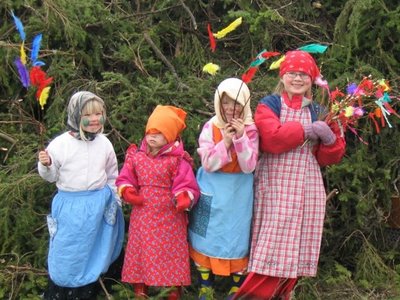
The Easter Witch? Yes, that’s what I said! There was an interesting AP article by Matti Huuhtanen that I found a few years back entitled “Little Witches in Finland Cast Good Spells Before Easter.” Needless to say, it got my attention.

I did a little digging in cyberspace and this is what I found. Apparently there is an unique and unusual tradition in Finland that involves little girls dressing up as witches and going door to door on either Palm Sunday (by children from Orthodox families in Southeast Finland), or Holy Saturday (by kids from the Lutheran families of Western Finland).

Children’s culture expert Reeli Karimäki of the Pessi Children’s Art Centre in Vantaa, had this to say abut the tradition: “In the most popular family tradition, young children (especially girls) dress up as Easter witches, donning colorful old clothes and painting freckles on their faces. “The little witches then go from door to door, bringing willow twigs decorated with colorful feathers and crepe paper as blessings to drive away evil spirits, in return for treats.”

Later, she adds “This Finnish children’s custom interestingly mixes two older traditions – a Russian Orthodox ritual where birch twigs originally represented the palms laid down when Jesus entered Jerusalem on Palm Sunday; and a Swedish and Western Finnish tradition in which children made fun of earlier fears that evil witches could be about on Easter Saturday.”

In the AP article, Matti Huuhtanen wrote “Ethnologists say Finland’s Easter practices came from the eastern region of Karelia, where Russian traditions were strong even when it was a part of Finland. Farmers in Karelia for centuries have taken pussy willows in lieu of palm leaves to their neighbors on Palm Sunday as a gesture of blessing.”

The candy of choice is chocolate foil wrapped Easter eggs which are placed in a copper pot the “little witches” carry with them. They also sometimes receive money, in the form of coins, as the treat. Those who make a donation are given a blessed willow branch in return.

I find this activity delightful and quite unique. The Pagan and Christian elements of this tradition live happily side by side and no one in Finland seems to bat an eye. It gives me hope that we can appreciate one another’s spring equinox celebrations, no matter what they may be!

Copyright ©2023 by David Taliesin, http://www.sabbatsandsabbaths.com

Posted in Easter | Tagged , , , | 1 Comment

Eostre/Easter Explored and Explained

I’ve rarely provided a link to a YouTube video but this one is fascinating for those who are interested in the connection, or non-connection, between the goddess Eostre and the Christian celebration of Easter. I’ve never found a more thorough analysis of this and found his arguments compelling. If you’re a history nerd like me, you definitely want to give this video a watch!

Posted in Uncategorized | Leave a comment

Declaration of Deeds/Declaration 127

Recently, in the midst of my study of Norse Paganism, I came across two very important statements that have been signed by a number of pagan/heathen groups and individuals: the Declaration of Deeds and Declaration 127 (version 2.0). I wanted my readers to know that I support both of these statements whole-heartedly. My blog is a safe space that honors all people and all spiritual paths as long as they don’t seek to oppress or demean others. If you ever see me use a source that does not align with these values, notify me immediate and I will remove it from my site. I’ve posted both statements below for your consideration. I also facilitate The Welcoming Circle with these values in mind.

Declaration of Deeds

We heathens, pagans, followers of the old ways, we are more than the choices that brought us into being; we are more than our orlay (i.e. fate, destiny). Instead, we are our deeds, we are the choices we make and not those chosen for us. In acknowledgement of this we declare the following points:

I. We endeavor to be better than our forebears. Their society was a product of its time and was often deeply flawed, but their religious belief in the gods we hold to be timeless. We endeavor to reconstruct their religion, not the flaws in their society.

II. Our religion gives no basis for discrimination based on race, ethnicity, or origin; the gods have nothing to say on the matter of race. We maintain that a person’s race, ethnicity, or origin does not impede their ability to participate in our religion or our group.

III. Our religion gives no basis for discrimination based on gender, including gender identity, or discrimination based on sex; our religion has divine and powerful goddesses and gods who are themselves complex at best. We maintain that a person’s gender or sex does not impede their ability to participate in our religion or our group.

IV. Our religion gives no basis for discrimination based on sexual orientation; the gods we worship do not always conform to one orientation or another and still hold their positions and importance regardless of their sexuality. We maintain that a person’s sexual orientation does not impede their ability to participate in our religion or our group.

V. Deeds matter to our communities and to our gods, deeds are the foundations of our reputations. We maintain that the basis we are to be judged on is through our actions and our deeds and not merely through circumstances beyond our control.

We are charged in the Hávamál to speak out against evil when we see evil; bigotry and discrimination based on the chances of our birth is just such an evil. We heathens, pagans, followers of the old ways; we join our voices in unison with this our Declaration of Deeds, that we may declare that the chances of our birth that are beyond our control have no bearing on our ability to participate in this religion nor to lead full spiritual lives, but rather that in all cases it is our actions and deeds that truly matter.

Declaration 127 2.0 

As in the past, today we are confronted with challenges and choices. Among the most difficult of these is how to respond to those who intentionally cause harm. As Heathens, our religion gives no basis for discrimination of any kind. Unfortunately, that has not stopped certain actors from trying to do so. Their actions force the wider Heathen community to adopt the qualifying word “inclusive” to define ourselves, and to stand against bigoted people who continuously twist the ancient Germanic religions towards exclusionary, hateful, and violent ends. It is illogical to place exclusionary limits on Heathenry.

We decry the damage the Nazi Party, their allies, and those of similar ideologies have caused historically. We also recognize the damage their ilk continues to inflict. They continually weaponize ancient Norse and Germanic symbols for use in campaigns of exclusion and terror against anyone who does not fit their fantasy. They dishonor our deities.

We hold that the deities themselves created and celebrate diversity. We hold that respect is an inherent right of all human beings. To violate those rights is to forfeit the community’s good graces. There is no greater dishonor.

The signatories listed below represent a diverse set of voices within modern Heathenry. They are national organizations, resource centers, authors, community leaders, local kindreds, and individuals. They come from every branch of our religion and walk of life.
These signatories have signed this Declaration to state their complete denunciation of, and disassociation from, any and all organizations that include any form of discrimination as described below as part of their policies and practice.

Declaration 127 signatories shall not promote, associate, or do business with any organization or entity so long as they practice discriminatory policies and exclusionary ideologies. Discriminatory organizations do not represent our communities. We do not condone hatred or discrimination carried out in the name of our religion and will no longer associate with those who do. 

We hereby declare that we will not maintain silence just to keep the peace, especially with those who would use our traditions to justify prejudice on the basis of: age, ability, health status, race, color, ethnicity, national origin (including ancestry), veteran status, gender, gender identity, sex, sexual orientation, socioeconomic class, or any other form of bigotry.

We stand together in defiance of unjust discrimination. Oppressive and exclusionary institutions shall receive no support from us. We will actively work against them in favor of a more welcoming faith community and society which embraces diversity, equity, and inclusion.

Posted in Uncategorized | Tagged , | Leave a comment

March Full Moon: Worm Moon

The-Worm-Moon

“Other seed fell into good soil and brought forth grain, growing up and increasing and yielding thirty and sixty and a hundredfold…Let anyone with ears to hear listen!” [Mark 4:8-9, NRSV]

According to the Farmer’s Almanac, March’s full moon “is traditionally called the Full Worm Moon by the Native Americans who used the Moons to track the seasons. Colonial Americans adopted these names, especially those named by the local Algonquin tribes who lived in the areas from New England to Lake Superior. At the time of this spring Moon, the ground begins to soften and earthworm casts reappear, inviting the return of robins. In some regions, this is also known as the Sap Moon, as it marks the time when maple sap begins to flow and the annual tapping of maple trees begins.”

On the evening of March 6th, we might want to use this time to think about the soil of our lives. Where is it “hard” and needs to be softened up so that green things can grow in it? In nature, worms provide this service! They increase the amount of air and water that gets into the soil. They also break down organic matter into nutrients that plants can utilize. Finally, their “castings” or poop is excellent fertilizer for the soil.

With this in mind, we can use this Worm Moon as a time to think about what we need to bring into our lives that will nurture us and provide an excellent environment for growth. In Jesus’ parable of the Good Soil, he reminds us that even the tiniest patch of fertile ground can yield amazing things; even a hundred times more than what we thought was possible. Let’s claim this promise for ourselves this spring and ask the Divine Presence to enrich the soil of our lives so that we may harvest beautiful and wonderful things when the time is right. Blessed be!

Copyright © 2023 by David Taliesin, sabbatsandsabbaths.com

Posted in Esbats, Uncategorized | Tagged , , , | 2 Comments

Fjölkyngi

“Magic Circle” by John William Waterhouse (1886)

Now there’s a word I didn’t know I needed in my life! Fjölkyngi (FYOL-koon-gee) is the Old Norse word for magic or witchcraft. It means “great knowledge” and, according to Diana L. Paxson, is “derived from the verb kunna which meant ‘to know’ but didn’t refer to just any kind of knowledge. It signified an understanding of the inner workings of people, things, and the world as a whole, as well as a mastery of an ancient lore and traditions.” Being a magician (fjölkunnigr) is not something you learn how to do in a five minute video on YouTube. It involves a lot of hard work and dedication to the craft, following whatever path the Spirit may lead you on.

Back in the day, when I was just a witching, I had been studying and practicing for about a year and happened to be visiting Asheville Raven & Crone. A young person came through the door and asked the clerk at the counter if they were hiring. The clerk said that they were welcome to fill out an application and also needed to list their five favorite books on magic and pagan spirituality. The person confessed that they had not read any books on the subject and I knew immediately they would not get the job. The clerk kindly accepted their application but without any knowledge of the Craft, it would be very difficult to work there! As I thought about myself applying for the job I had already read 25-30 excellent books at this point and was also a member of a training coven. It would have been nearly impossible for me to pick just five because there were so many excellent ones to choose from! I would have also been hesitant to apply for the job because I still felt like a toddler in terms of my magic practice and still had lots to learn before I could help others in a store such as this.

Im my own pursuit of “great knowledge,” I’ve alway been a spiritual mutt, sampling from many different traditions to form my own unique path. I encourage others to do the same. I’ve always had a thirst for knowledge and it led me to pursue a masters degree in theology in the Christian tradition. I’ve also had Buddhist, Wiccan, Medicinal Herb and Norse Pagan teachers, along with an extensive study of Tarot. My current obsession is runes and it quickly dawned on me that in order to understand them you also need to have a basic grasp of ancient Norse history, language and customs. So that’s what I’m doing these days! It is a joyful journey but it is also a lot of hard work.

I share this with you to encourage you to always seek to gain more knowledge and acquire more skill in whatever traditions you’re studying. The well is deep, but the water is oh-so sweet! This depth of knowledge will serve you well and will make your fjölkyngi strong. Blessed be!

Copyright ©2023 by David Taliesin, http://www.sabbatsandsabbaths.com

Posted in Magic, Norse/Germanic Spirituality, Spirituality | Tagged , , | Leave a comment

The Naming of the Divine: A Non-Binary Perspective

Lately, I’ve been reading more and more articles written by practitioners of magic who identify as non-binary, gender-fluid, etc. Many of them are expressing their desire for us to move beyond the traditional god/goddess language when referring to the Divine and adopt a more inclusive approach.

I must admit, I totally relate to their struggle with this issue. Growing up as a Christian, I reached a point where the male-dominated language of my faith no longer worked for me. I began infusing some feminine energy into my concept of the Divine, always referring to the Holy Spirit as a “she” and trying my best to get away from “Lord” language when referring to the Creator by using other nouns such as “Eternal One” (which is what the Hebrew word YEHOVAH actually means instead of “Lord”). When the goddess Brigid entered my life, the feminine aspects of the Divine were a permanent part of my spiritual life which feels a lot more balanced than it did before.

That being said, while my spiritual life includes Divine aspects that are both traditionally male and female, I often seek terms for the Divine that move beyond gender completely. This is especially true as I write liturgies for both Christian and Pagan gatherings. For example, when casting a circle I often welcome the “Divine Presence, who is known to us by many names.” One of the reasons I do this is that The Welcoming Circle, which I lead at Asheville’s Raven & Crone, is open to people of all spiritual paths. I try to honor all the names we attach to the One we know as the Divine.

My biggest source of inspiration for naming God more inclusively are the various Native American spiritualities, some of whom refer to the Divine as the “Great Spirit,” or my personal favorite the “Great Mystery,” since none of us can completely understand nor comprehend the Divine.

Recently, I’ve been using the First Nations Translation of the New Testament which came out in 2022. While it uses male pronouns when referring to God, it also gets creative with more generic terms for the Divine such as “Maker of Life” and often uses “Great Spirit” or “Creator” in place of “God.” It also takes a few steps toward inclusivity by using “sacred family members” instead of Paul’s typical “brothers and sisters” in his letters. It also describes the “kingdom of God” as “Creator’s good road” which I really like.

Language is always an evolving thing. The point of this article is to get us thinking about the names and pronouns we use to describe the Divine. I encourage all of us to listen to our non-binary siblings because they have some important wisdom to share with us!

Copyright ©2023 by David Taliesin, http://www.sabbatsandsabbaths.com

Posted in Spirituality | Tagged , , , | Leave a comment

The Wanderer’s Hávamál

Six months ago, when I began an intensive study of the Elder Futhark Runes, I had no idea how deep the rabbit hole would go. I found myself learning some Old Norse language and delighted in reading the myths and legends found in The Poetic Edda. Perhaps the most well-know portion of this collection of writings in the Hávamál which can be translated as “Words of the High One.” It’s narrated by Óðinn and is a treasure trove of sage advice, including Óðinn’s story of how he obtained the runes.

There are lots of antiquated translations of the Hávamál out there that are in the public domain (Olive Bray, Henry Adams Bellows). However, there are times when one wants to read a more modern take of these classic poetic stories.

Well, look no further than Jackson Crawford’s The Wanderer’s Hávamál. It is truly a labor of love and a thing of beauty. Crawford is a Norse scholar whose YouTube channel is a must see. His videos are what led me to discover that one cannot master the runes without a deep dive into Norse mythology and culture.

The Wanderer’s Hávamál began with Jackson going back to the Codex Regius, which is the original source for these poems, and preparing his own Old Norse text from it. This is an important step because there are lots of abbreviations in the Code Regius and very little punctuation. Then from his version of the Norse text, which is published in the book, he gives us a fresh translation in modern English. It really makes the Hávamál come alive, and I cannot recommend it highly enough.

The delightful bonus in this book is The Cowboy Hávamál where Crawford ‘s creativity shines brightly. It takes stanzas 1-81 of the Hávamál and gives it the voice of his grandfather June Crawford. It is not to be missed and as far as I know is only found in this book. Fans of the TV series Yellowstone will love it.

As if that’s not enough to convince you to purchase this book, Jackson Crawford’s extensive notes are a treasure trove of insight and information. If you’re a bookworm like me, you will find this section as refreshing as a horn of mead. What are you waiting for? This book is a definite must in your collection of Norse literature.

Copyright ©2023, by David Taliesin, http://www.sabbatsandsabbaths.com

Posted in Norse/Germanic Spirituality, Runes | Leave a comment