Myrrh: From Birth to Death and Everything In-Between

myrrh

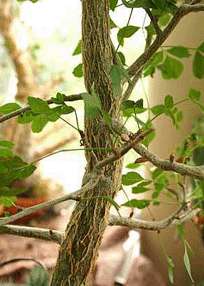
Myrrh Tree

On entering the house, they saw the child with Mary his mother; and they knelt down and paid him homage. Then, opening their treasure chests, they offered him gifts of gold, frankincense, and myrrh. [Matthew 2:11, NRSV]

When most people are asked what myrrh is, the typical response is “That’s one of the three gifts given to baby Jesus by the wise men.” Yet, if you asked these same people why he received such a gift, they haven’t a clue. Myrrh is a tree resin that is an ingredient in incense, oils, perfumes, and medicine. Earliest uses of myrrh include the Egyptians who embalmed mummies with it and traditional Chinese medicine where it is valued for helping to cure circulatory problems, arthritis, and uterine tumors.

Myrrh also has a rich history in the Judeo-Christian community. Exodus 30 lists myrrh as the first ingredient in a recipe for anointing oil that was used to consecrate the tent of meeting (tabernacle), ark of the covenant and all ritual tools used in this sacred space. It is also mentioned in Psalm 47 as an ingredient in the “oil of gladness” that is used to perfume the robes of the groom in a royal wedding.

In addition to its use for consecration and purification, myrrh also has a seductive/erotic side which is reflected in an adulteress’ invitation in Proverbs 7:17—”I have perfumed my bed with myrrh, aloes, and cinnamon. Come, let us take our fill of love until morning; let us delight ourselves with love.” Or perhaps, more provocatively, Song of Songs 1:13—”My beloved is to me a bag of myrrh that lies between my breasts.”  Cue the Barry White music!!!

It is also interesting that myrrh appears at three pivotal moments in the life of Jesus: at his birth which I already mentioned, while hanging on the cross (Mark 15:23) where Jesus was offered wine mixed with myrrh, and after his death (John 19:30-40) where his body was wrapped in a mixture of myrrh, aloes and linen cloth.

Modern Wiccans attribute similar qualities to myrrh.  According to Witchipedia, “Myrrh resin may be burned as incense for purification, exorcism, protection and healing.”  In The Element Encyclopedia of 5,000 Spells, Judika Illes says “Burn myrrh to ease and illumine a person’s transition between life and death.” She also suggests you “Burn myrrh as incense in the bedroom to stimulate erotic dreams, if you’re sleeping solo.”

My go-to guy, Scott Cunningham, warns that myrrh should not be used if you are pregnant.  He also says that when burned, myrrh “purifies the area, lifts the vibrations and creates peace.”  It also “aids meditation and contemplation.”

A good DIY tip when preparing the resin for incense is to use a coffee or spice grinder that is dedicated to magical use.  Myrrh is very hard resin and is nearly impossible to crush with a mortal and pestle.  Trust me on this!  The coffee grinder is the way to go.

Finally, to answer the question “Why did baby Jesus receive myrrh as a gift?,” the answer should be fairly clear.  The Magi, i.e. the magicians, would have used myrrh to consecrate sacred space and sacred people.  It was their way of honoring the One they had been led to by following the astrological signs in the sky.

Copyright ©2015 by sabbatsandsabbaths.com

Posted in Christmas, Epiphany, Herbology, Incense | Tagged , , , | 2 Comments

‘Tis the Season to Make Witch Balls

Since I’m such a DIY crafty person, I just had to share this idea. These are absolutely gorgeous!

moodymoons's avatarMoody Moons

Witch balls are an Old World pagan tradition.  Hang them in windows, over beds to ward off nightmares, in the garden to bless new growth, in kitchen to welcome good spirits or over doorways to protect the entrance.  The glass of the balls is believed to deflect negative energy.

I filled mine with all-natural ingredients like rose (for a loving home) and cinnamon sticks (for protection).  I even picked fresh green moss from the garden and preserved it using a new method I just learned.  I think it came out cute!

IMG_2876IMG_2888

Hopefully it will inspire you to create your own, or if you’re not so crafty, I’ll be happy to make one for you!

post sponsered by

View original post

Posted in Uncategorized | Leave a comment

Juniper Berries: Protection and Healing

junipertwigberriesMaybe it’s because of my Germanic heritage but I’ve always loved juniper berries. The best sauerkraut recipes use them as a flavor enhancer and I wouldn’t have it any other way. Juniper berries are also used to flavor gin which I’ve never enjoyed drinking. But my favorite use for them is in magical incense. I have an allergy to pine resin/needles.  The resin/needles make my skin break out in little red bumps and the scent causes my sinuses to become congested. That may be too much information but I share this with you because you might be in the same boat!

Luckily, juniper berries can be substituted for pine in many magical workings. While Scott Cunningham warns that they can also cause an allergic reaction, I find they work beautifully and powerfully for me! (He also says that pregnant women should not use them so be forewarned!) Juniper berries have Sun/Fire energy and are used in spells for exorcism (repelling negative energy), protection, healing and love. Since most of my magical work is for healing and protection, they are one of my go-to herbs. They grow plentifully in my area so I harvest them locally which is important to me. I only take what I absolutely need for the coming year since birds will eat them during the winter when other food sources aren’t available.

Juniper berries can be a bit sticky, even when dried, so I only crush them gently with a mortal and pestle when using them in incense blends. They combine wonderfully with rosemary which is another powerful protection/healing herb. I use them in the following incense blend when I want to raise power in a circle as I prepare to do healing and protection magic:

Aries Incense (adapt. from Scott Cunningham)
2 parts Frankincense
1 part Juniper berries
1 part Cedar leaf tips

Historically the use of juniper berries goes back to at least ancient Egyptian times. They were also one of the earliest incenses used by Mediterranean witches. When the Black Death ravaged Europe, juniper was thought to be an effective protector. It was also considered to be a guardian of the veil between the worlds. I couldn’t find any specific use of juniper by Christians (other than they probably used it during the Black Death like everyone else) so if you have any information, please let me know.

But aren’t junipers mentioned in the Bible? Yes, the King James Version of the Bible mentions “junipers” but this is actually a bad translation. The Hebrew word “rotem” or “rothem” is actually a Spanish broom or white broom tree. It is not a juniper in the least and is very abundant in the Sinai desert. The most well known Bible story regarding a broom tree is in 1 Kings 19 where the prophet Elijah throws a pity party for himself, sits under a broom tree, and asks God to take his life. God ignores his request and, instead, sends Elijah an angel who gives him bread and a jar of water! (No juniper trees were involved in the telling of this story or any other Bible story!)

Copyright ©2015 by sabbatsandsabbaths.com

Posted in Herbology, Incense, Magic | Tagged , , | 1 Comment

Juniper Berries: My Final Fall Harvest of the Year

We finally had a sunny day in my hometown after weeks of rain.  This afternoon I made a beeline to a stand of juniper trees whose berries were ripe and ready for harvest. I love to use these berries in incense blends. My absolute favorite is a tweaked version of Cunningham’s Ares incense found in his indispensable book Incense, Oils and Brews:

2 parts Frankincense
1 part Juniper berries
1 part Cedar leaf tips

I have an allergy to pine and when it burns my sinuses get stuffed up.  I also have to wear a long-sleeved shirt and gloves if I’m handling the branches or my skin will break out in tiny red bumps. Much to my surprise, I discovered that I don’t have the same reaction to juniper which can be a substitute for pine in magic recipes. So, if you also have a pine allergy you might want to give this a try!

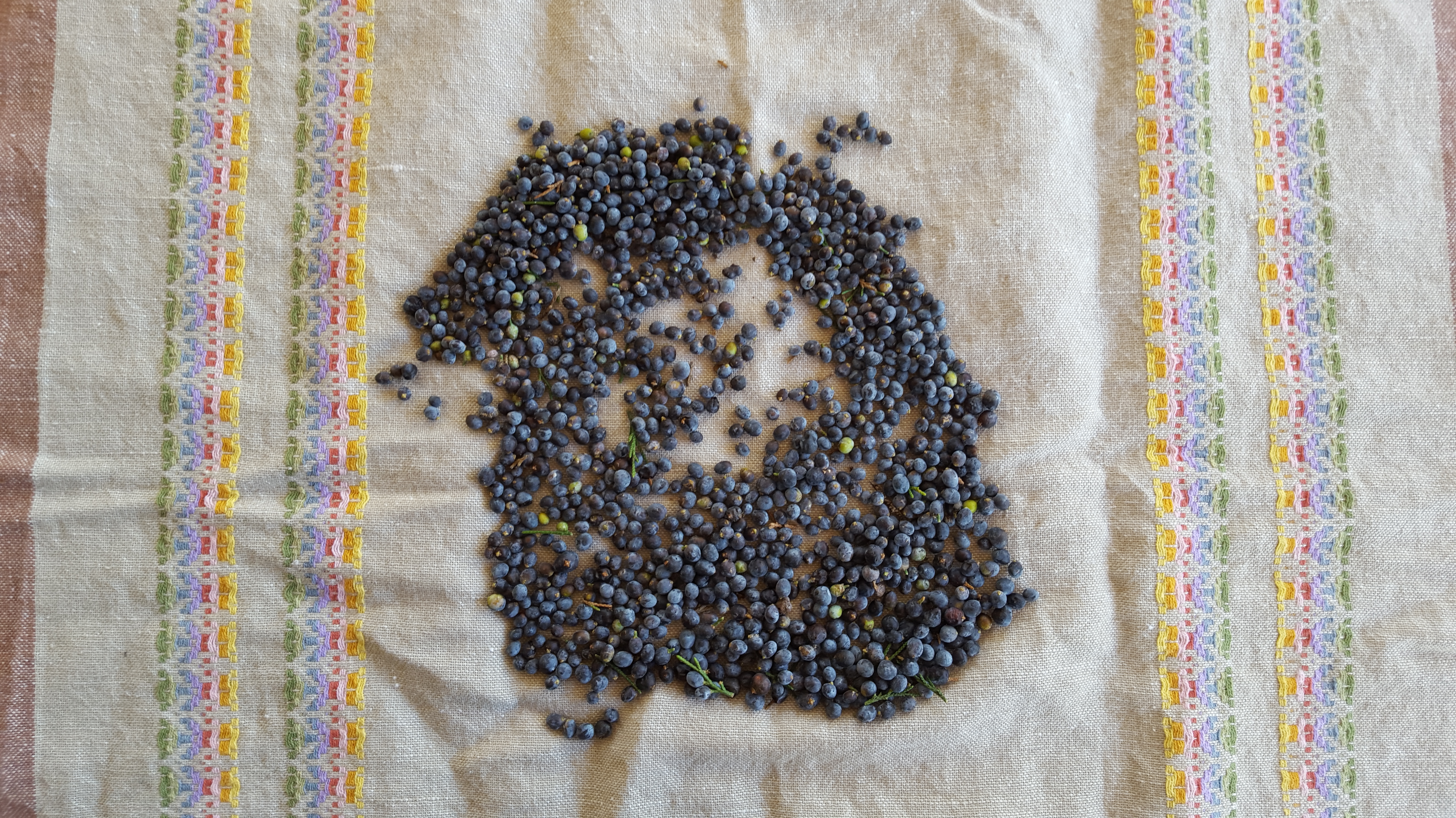
20151110_145254Juniper berries are harvested only when they turn a deep bluish purple in the fall. Earlier in the season they are usually green. If the tree is immature, the berries remain green all year long and should not be harvested. The berries should turn blue the year after that so keep your eye out for mature trees.

20151110_150807

Once the berries are collected I spread them out over a towel to keep them from rolling all over the place! Then I sort through the berries discarding those which are green or just don’t look right! I also toss any twig or leaf debris that came along for the ride. My philosophy is that I only harvest as many berries as I need and leave the majority of them on the tree. Birds will eat them in the winter if there are no other food sources around.

20151110_152156

Finally the berries go on a cookie sheet and air dry for about three weeks. I then will give them a final inspection and remove any that have turned brown or have little holes in them which might indicate that they have bugs!

Copyright ©2015 by sabbatsandsabbaths.com

Posted in Herbology, Incense | Tagged , , , | Leave a comment

Cycles of the Sun and the Moon in Our Lives

Source: Cycles of the Sun and the Moon in Our Lives

This is such a wonderfully written article.  Lots of food for thought!

Posted in Uncategorized | Leave a comment

What is Magic?

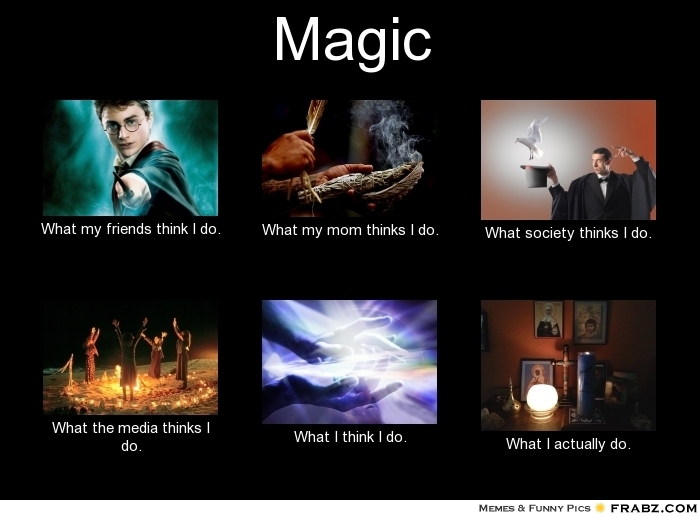
magicwhatidoThe meme above reflects my experience when talking to others about “what I do” when I say I practice magic. Thanks to films like Harry Potter and The Craft, society has a very distorted view of what this ancient art entails. My Mom is starting to catch on and even asked me to do a smudging in front of her house after a bicyclist was hit by a car [Thankfully he lived to cycle another day!] However, she doesn’t really press me for more details! She thinks of me more as a healer, which is mainly what I do, but she would never call me a Christian witch, which is what I am.

So, what is magic? It is an art that is practiced in many spiritual traditions such as Wicca, Druidism, Native American spirituality, Christianity, Judaism, and many more. It is also practiced by some with no spiritual component to it at all. If you spend any time reading books or trolling the internet, you’re likely to discover a myriad of definitions regarding what magic is, some of which are just plain ridiculous.

Are there any universal traits to magic that tie together all those who practice the Craft?  To be honest, I’m not really sure there is.  If I’ve learned anything for my Wiccan friends, it’s that you do whatever works for you.  There are no hard and fast rules, just lots of experimentation and failure until you find those tools that are most effective.

That being said, I do think there are a few things that tie most of us magicians together.  My favorite definition of magic is from Scott Cunningham who says in his book Wicca: A Guide for the Solitary Practitioner, “I’ve defined magic a number of times in my books.  Surprisingly, this is a difficult task. My latest, most refined definition: Magic is the projection of natural energies to produce needed effects.  There are three main sources of this energy—personal power, earth power, and divine power.”

If there is anything we have in common, I believe it is working with these three energies to affect change in the world around us. We may use different tools and techniques to get the job done, but the heart of magic has to do with raising and sending energy.  This requires learning how to focus our will and make our intention clearly known to the Universe.

Adelina St. Clair in The Path of a Christian Witch states this very well: “As I tried to synthesize all that I learned about magic, it became apparent that basic magical theory is extremely simple.  Yet its true application is worthy of the greatest spiritual masters.  Magic has two major components: The Will and the Word.”  Will, in its simplest terms, means how passionately we want our goal to be achieved. Word has to do with how we make that request known to the Universe.

If I’ve learned anything about the Craft, it is that all the tools, techniques and spells we use will be ineffective if we cannot master both Will and Word. Some people spend too much time worrying if they have the right color candle or possess the perfect spell to get the job done.  If we are unable to learn to ground, center ourselves, and focus solely on our magical goal without other distractions getting in the way, our magic will always be weak and ineffective.

So, I’d love to hear from you on this subject! What does magic mean to you?  Is there anything that ties all of us magical people together?  Inquiring minds want to know!

Copyright ©2015 by sabbatsandsabbaths.com

Posted in Magic | Tagged , , , , | Leave a comment

Trump 10 – Wheel of Fortune

wheel01

Rider-Waite Tarot

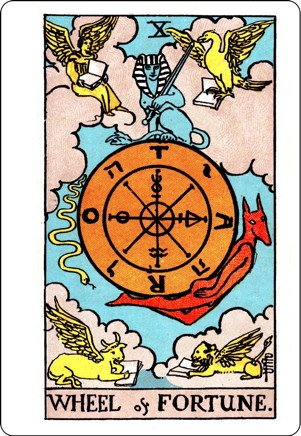
As for the appearance of their faces: the four had the face of a human being, the face of a lion on the right side, the face of an ox on the left side, and the face of an eagle; such were their faces…As I looked at the living creatures, I saw a wheel on the earth beside the living creatures, one for each of the four of them. As for the appearance of the wheels and their construction: their appearance was like the gleaming of beryl; and the four had the same form, their construction being something like a wheel within a wheel.  [Ezekiel 1:10-11,15-16 NRSV]

The Wheel of Fortune is one of those cards were I prefer the DruidCraft interpretation over the Rider-Waite version. The Rider-Waite card draws its inspiration from a vision of the prophet Ezekiel who speaks of the four Living Creatures who had the face of a human, a lion, an ox, and an eagle. These four faces would eventually correspond to each of the four gospel writers in the New Testament.

The wheel also comes from Ezekiel’s vision, but it also gets most of its symbolism from the work of Eliphas Levi, a French occult author and ceremonial magician. The symbols on the outer ring of the wheel include the four Hebrew letters that spell the name of the Divine Presence, YHWH. The  four English letter can be interpreted three ways: T-A-R-O for “tarot,” T-O-R-A for “torah,” or R-O-T-A which is Latin for “wheel.” The last interpretation comes from the medieval concept of Rota Fortunae, the wheel of the goddess Fortuna. Therefore, this card is sometimes entitled “Fate,” depending upon the deck. Some commentators say the inner markings on the wheel are alchemical symbols for the four elements: Earth, Air, Fire and Water but I believe this is incorrect.  As far as I can determine they represent salt, sulphur, mercury and water. Anyone have any additional insights on this?

This final creatures on the Rider-Waite card include an Egyptian Sphynx which represents the cycle of life, along with two references from Greek mythology: Typhon in snake form and Hermanubis.  In the book Tarot for Christians the author says the three creatures symbolize “transformation, blessing and decay.”

wheel02

DruidCraft Tarot

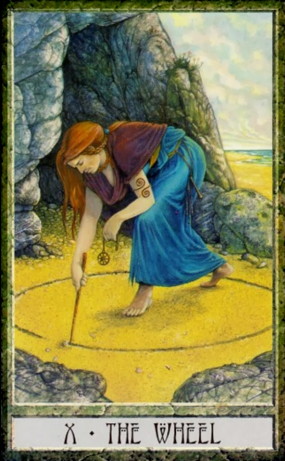
Personally, I think all this symbolism is overkill. It’s used to describe something that can be summed up in one sentence from Ecclesiastes 3:1, “For everything there is a season, and a time for every matter under heaven.” When the Wheel of Fortune card appears, I know it’s time to pay attention to patterns in my life and in the world around me. It’s time time to look at the bigger picture rather than getting bogged down in minute details.  It’s also a time to name the “season” I am in (birth, growth, harvest, and rest) and align myself with its purpose in my life.

This is why I find the DruidCraft version of the Wheel of Fortune so appealing.  It’s simply called “The Wheel” which represents both the Sacred Circle and the Wheel of the Year. Its simple elegance is in sharp contrast to the frenzied symbolism of the Rider-Waite version. The DruidCraft Wheel invites us to let go of tension and worry, ground and center ourselves, and listen to what the Universe is trying to teach us at this given moment in our lives.  Philip Carr-Comm sums up the meaning of this card as “You can see the patterns in your life and the wider patterns on the cycles of birth, life, death and rebirth. Harvesting the seeds of destiny, you continue to sow seeds of love.” Works for me!  What more really need to be said?

The Wheel of Fortune is a powerful card with deep and profound meaning.  When this one appears in your readings, don’t rush over it too quickly.  Give it the attention it deserves and you will be richly rewarded for the insights it provides.

Copyright ©2015 by sabbatsandsabbaths.com

Posted in Tarot | Tagged , , | Leave a comment

Trump 9 – The Hermit

hermit02

Rider-Waite Tarot

Be still, and know that I am God. [Psalm 46:10, NRSV]

The kingdom of God does not come in a way that can be seen, nor will people say “Look, here it is!” or “There it is!”; for the kingdom of God is within you!  [Luke 17:20-21, OEB]

The Hermit is one of my favorite cards in the Tarot deck because it mirrors a lot of my personality. For me this card speaks of discovering the Great Mystery, not by seeking it in the outside world, but by turning inward. This notion is not only spoken of in Biblical texts such as those above, it is also reflected in Pagan spirituality as well. In The Charge of the Goddess, Doreen Valiente states this truth beautifully: “If that which you seek cannot be found within you, you will never find it outside of you. For behold, I have been with you from the beginning; and I am that which is attained at the end of desire.”

As we look at the Rider-Waite version of The Hermit, we notice that his lamp is illuminated by a star instead of a candle.In Pagan symbology, the star relates to Goddess energy which includes intuition and hidden mysteries. It’s the kind of knowledge that is not attained easily but is definitely worth the effort!  It’s also the kind of knowledge Christian mystics have spoken of ever since there were Christian mystics One of my favorite quotes on the subject is from Meister Eckhart, a 14th century Dominican priest: “Spirituality is not to be learned by flight from the world, by running away from things, or by turning solitary and going apart from the world. Rather, we must learn an inner solitude wherever or with whomsoever we may be. We must learn to penetrate things and find God there.”

Arthur Waite also provides some helpful commentary on the meaning of the Hermit.  He says it blends the ideas of the Ancient of Days (a Hebrew name for the Divine) with the Light of the World (a title Jesus used to describe himself). Waite also warns about misinterpreting this card, saying, it is not “a wise man in search of truth and justice; nor is he…an especial example of experience. His beacon intimates that ‘where I am, you also may be.'” I take this to mean that we can never really grasp the Ultimate Truth. Instead we draw near it as we draw near to the Divine.

hermit01

DruidCraft Tarot

The DruidCraft version of the deck adds a wolf and a crescent moon. Both of these reinforce the themes I’ve mentioned so far. When the wolf shows up as a totem animal it can mean we should pay attention to what our intuition is telling us.  The moon, of course, is all about the Goddess. Philip Carr-Gomm also summarizes the Hermit card in the DruidCraft deck with the following: “Turn away from the distractions of the outer world, and see guidance. In silence and solitude discover new depths, and refresh your soul at the source of all life.”

For me this card tells us it’s time to be very quiet and try to listen to the voices of the Ancient Ones/Divine Presence and the wisdom they can impart to us.  It’s not a time for decision-making but is a time to withdraw from the distractions of life until the way forward is clear.

Copyright ©2015 by sabbatsandsabbaths.com

Posted in Tarot | Tagged , | Leave a comment

Mugwort: John the Baptist’s Girdle?

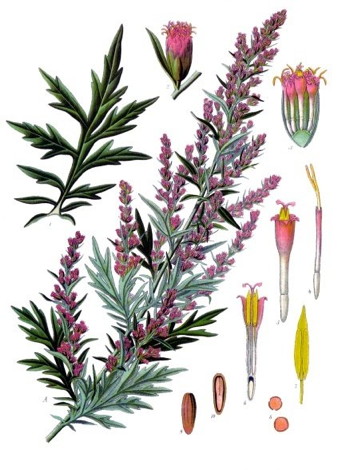
mugwort01Mugwort is one powerhouse of an herb that has been used since ancient times for cooking, beer-making (before hops), magic, medicine, smudging, protection, dreamwork and more. It’s genus name is Artemisia since it was dedicated to the Greek moon Goddess Artemis whose Roman name is Diana. It has a long history of use in China, Japan and throughout Europe. Native Americans value the plant as well.

While one of the common names of mugwort is St. John’s Plant, it should not be confused with St. John’s Wort which is a completely different herb. (I have seen this misidentification in several places on the internet!) The name St. John’s Plant comes from an amusing Christian tradition. According to Witchipedia, “in Holland and Germany the plant was considered sacred to John the Baptist who presumably wore a girdle of mugwort! The plants were also gathered on St John’s Eve, made into a crown and worn to protect the wearer from demon possession, disease and general misfortune.”

Judika Illes in The Elemental Encyclopedia of 5,000 Spells, also nots the origin of the story: “Allegedly John the Baptist wore a girdle (belt) woven from mugwort while in the wilderness.  A similar magic belt allegedly provides you with good health.”  She also offers the following suggestion for it’s modern magical use: “In time for St. John’ Eve, weave a magic belt from mugwort, knotting your ropes and intentions into the girdle.  Wear it while dancing around the bonfire; at some point before the night ends ‘and the bonfire burns out, toss the belt into the flames to receive a year of good heath.

The medicinal uses of mugwort are well documented on other web sites so I will not cover it here. My interest in this wonderful herb has to do with its magical properties.  As a protection herb, it can be made into a smudge stick and used to ward off negative energies/spirits. Native Americans also used it in cleansing rituals and sweat lodges. In ancient times it was hung over doorways for protection and was also placed inside Roman soldiers sandals for the same reason.

As a dream herb, it can be brewed into a tea (there are some precautions to this so read carefully before you ingest it!) or, more safely, placed in a dream pillow. It is believed mugwort helps us to better remember our dreams, both during sleep and in shamanic trances. A Wiccan priestess friend of mine also recommends that a sprig of mugwort should be placed in the room of a person who is dying since it is a bridge between the worlds.

I have also heard that dried mugwort added to a fire will help keep it smoldering for a long time, and the stalks make good kindling. Furthermore, mugwort’s long stems and beautiful leaves make wonderful wreathes and garlands. Did I also mention its easy to grow…but be careful so it doesn’t take over your herb garden!

Copyright © 2015 by sabbatsandsabbaths.com

Posted in Herbology | Tagged , , | 1 Comment

Book Update

I’m excited to report that most of my research is finished and I have both a working title for the project and a complete outline of it’s contents!  The title is…

The Green Path: Walking With Jesus Through the Wheel of the Year
Copyright ©2015 by David Taliesin

greenpath01

It will include 52 selected teachings of Jesus from both Biblical and non-Biblical sources (I’ve already selected them) that will be placed on the weeks of the Wheel of the Year and correspond to its themes.  Each entry will have both a commentary and questions for reflection.

I’m excited about this project and writing will continue through the fall.  I hope it will appeal to Christians who are looking for another approach to Jesus other than what traditional Christianity has to offer.  I also hope it will appeal to Pagans, some of whom may wonder if Jesus has any wisdom that might be useful in their spiritual journeys.

I’ll keep you updated as the work progresses!  Blessed be and Amen!

Copyright © 2015 by sabbatsabsabbaths.com

Posted in Spirituality | Tagged , , , | Leave a comment