I’m currently recovering from minor surgery, and during a particularly rough day this past week, I felt called to reach into my rune bag, hoping for a little guidance and encouragement. Normally, I draw a single rune. But this time, three came out together, as if they had something important to say — not just about my healing, but about the larger world we’re living in.
The runes were Tiwaz, Laguz, and Othala.
Here’s the message they offered — one that speaks not only to my personal journey but, I believe, to the collective moment we find ourselves in as a nation:
Tiwaz — This is the rune of the spiritual warrior. It calls us to act with courage and integrity, to stand up for what we know to be just and true. Inaction is not an option.
Laguz — Representing water and flow, Laguz reminds us to stay grounded and calm, especially amid the noise and chaos of the world (and social media). Clarity comes when we choose stillness over reaction.
Othala — This rune speaks of heritage, home, and community. It encourages us to lean on our loved ones, our chosen families and tribes, for support — and to offer that same support to others whenever we can.
If you’re reading this, maybe this message was meant for you, too. Wishing you strength, peace, and blessings on your journey.
Sometimes, we need a reminder of just how resilient nature truly is—a quiet nudge that encourages us to believe in our own ability to recover and thrive.
In September 2024, Asheville faced the fury of Hurricane Helene. The storm left our beloved landscape scarred and stripped bare. Trees were downed, gardens flattened, and the once-lush surroundings looked desolate. It felt like a loss not just of beauty, but of stability.
Then spring arrived—and with it, hope. Little by little, green returned to our yards and mountainsides. Like many in our community, I found comfort in planting again. Nurseries and farmers markets were buzzing as people selected herbs, flowers, and vegetables to fill the empty spaces in their gardens. It felt like we were all planting more than just seeds—we were planting hope.
But on May 8th, just as new life had begun to take root, a fierce hailstorm swept through the area. It tore through delicate hostas, pounded flower beds, and threatened the young plants we had just lovingly tucked into the earth. I remember rushing outside as soon as the hail stopped, anxiously inspecting every stem and leaf, silently willing them to survive.
And then—something amazing happened.
May and June brought steady, generous rains. Day by day, my garden began to thrive in a way I hadn’t seen in years. My medicinal herbs grew taller and more vibrant than ever before. Elderberry bushes bent under the weight of fruit. Flowers bloomed with a richness and intensity that made me stop in awe. Even my tiny fig bush, planted just a week before the storm, surprised me with its first few fruits—small, but full of promise.
Time and again, nature reminds me that new life can blossom even after the harshest conditions. It’s a lesson I’ve needed to learn—and one I want to share.
Whatever storm you may be facing right now, I hope it is soon followed by a season of growth and renewal. Nature holds that hope for all of us. Hold on to it. Let it nourish you.
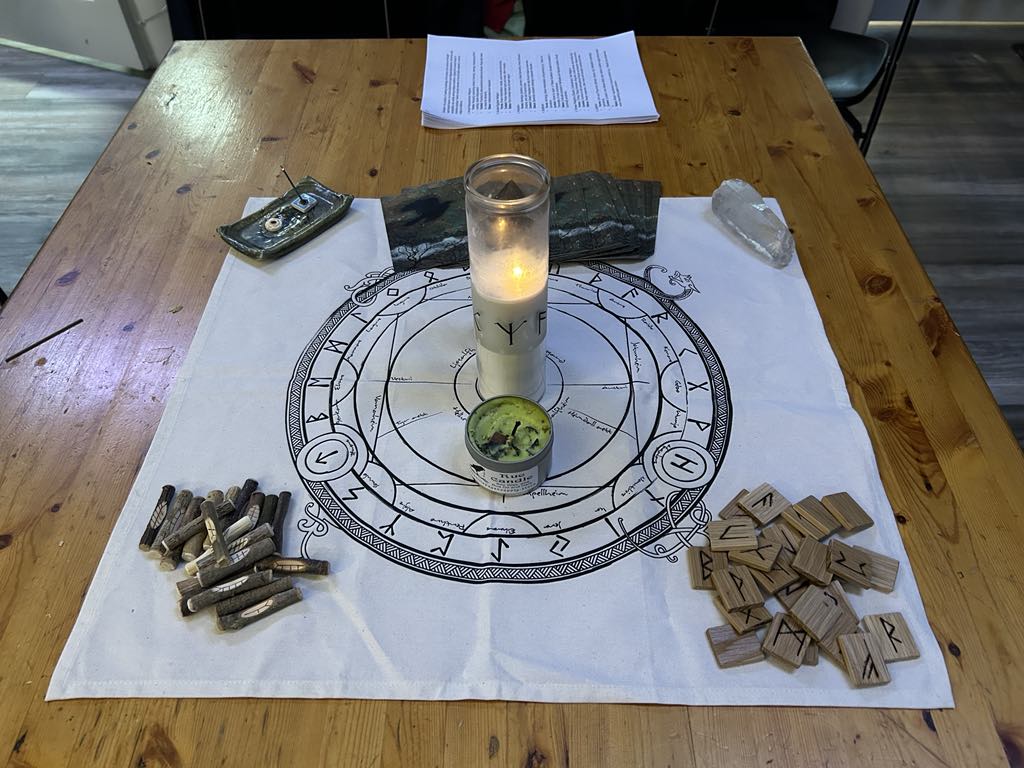
This is the ritual we did at both yesterday’s Rainbow Circle and Welcoming Circle. Enjoy!
DIVINATION RITUAL
CANDLE LIGHTING—David Taliesin Sprinkle some eyebright into the flame of the central pillar candle. Say…
May our time together bring clarity to those who seek it. May we gather wisdom for the journey that lies ahead of us So mote it be!
CASTING THE CIRCLE—David Eck (adapted form of the Protection Prayer} Use an athame to cast the circle [mine is made of quartz] Say the following:
The light of the Divine surrounds us, The love of the Divine enfolds us, The power of the Divine protects us, The presence of the Divine watches over us. Wherever we are, the Divine is. All is well.
CALLING THE QUARTERS—David Taliesin Guardians and ancestors of the East, Divine powers of insight and discernment, Aid us in our work today. May it help us to see the way forward more clearly. Hail and welcome!
Guardians and ancestors of the South, Divine powers of decision-making and judgement, Aid us in our work today. May we learn how to separate truth from deceit. Hail and welcome!
Guardians and ancestors of the West, Divine powers of empathy and love. Aid us in our work today. May it be a source of healing for our weary souls. Hail and welcome!
Guardians and ancestors of the North, Divine powers of stability and prosperity, Aid us in our work today. May we find a way to overcome any obstacles That are keeping us from moving forward. Hail and welcome!
We honor Sophia, holy wisdom of the Hebrew people. We honor Thoth and Hermes Trismegistus, Keepers of the secrets of the universe. We honor the Norns weaving our destinies, and Oðin who pursued knowledge at all costs. We honor Cheridwen, keeper of the cauldron of knowledge. We honor Ganesh, god of wisdom; luck, and new beginnings. We honor Pythia, the Oracle at Delphi and Athena, goddess of wisdom and war strategy. We honor the ancient seers of all cultures, And all forms of the Divine Who guide us faithfully each and every day. Hail and welcome!
DISCERNMENT RITUAL—David Taliesin
First part of the exercise is to practice grounding so that participants feel connected to the energy of the earth. The second part is to pull divine energy from above and let these two energies intermingle in our bodies. Go with whatever imagery this looks like to individual participants.
Then have them direct this energy through their dominant hand [or both if you’re magically ambidextrous!] toward a spread of oracle cards. The goal is to have them select one based on its “temperature” or vibration. Not every one has this gift of discernment but the hope is that some may uncover it for the first time.Have them pick one card that will give them wisdom for how to navigate the rest of the week.
When everyone has done this, have their share what they experienced if they’re willing.
CLOSING THE CIRCLE—David Taliesin Guardians and ancestors of the North, Divine powers of stability and prosperity, We thank you for your presence in our circle today. Stay if you will. Go if you must. We bid you farewell!
Guardians and ancestors of the West, Divine powers of empathy and love. We thank you for your presence in our circle today. Stay if you will. Go if you must. We bid you farewell!
Guardians and ancestors of the South, Divine powers of decision-making and judgement, We thank you for your presence in our circle today. Stay if you will. Go if you must. We bid you farewell!
Guardians and ancestors of the East, Divine powers of insight and discernment, We thank you for your presence in our circle today. Stay if you will. Go if you must. We bid you farewell!
We give thanks to the Divine Presence Who goes by many names And who appears in many forms. We thank you for your willingness to guide us During these difficult times. Stay if you will. Go if you must. We bid you farewell.
The circle is open but never unbroken Because it is a circle woven in love. Whatever energy is left in this space We return to the earth with a spirit of gratitude. Merry meet and merry part, and merry meet again.
In traditional Christian theology, there are three separate parts that make us who we are: body, mind, and spirit. Thanks to St. Paul, most Christians share the belief that these three are at war with one another. Our spirits struggle to triumph over our bodies (flesh) as well as our minds (our thoughts and desires). As far as I’m concerned, it’s downright exhausting. It’s also contradictory to my lived experience. The Christian mystic and Buddhist in me is always seeking to bring these three into harmony with one another. Most of the time, I’m fairly successful in this endeavor. I do not view the body as evil or weak. In fact, it is the temple where the Divine chooses to dwell. Furthermore, we cannot neatly separate these three things since they are intertwined with each other. If I’m constantly thinking negative thoughts, it tends to show up in illness in my body. If I’m having a spiritual crisis, it clouds my judgment and scrambles my thoughts. I think you get the point.
Recently, I did a deep dive into traditional Norse spirituality and its concept of the self. While there is no standardized set of components, there are four that consistently come up in the source materials I examined. They present a very different view of what makes us who we are. I’ll cover them briefly in this post and then I’ll go into more detail later. I don’t completely resonate with this set of components either, but I found them utterly fascinating. They are quite different from the traditional Christian view.
The four components that make up the self are hamr, hugr,fylgja, and hamingja. While these four parts exist together, they can also detach themselves from one another in certain circumstances. This makes them a lot more flexible and fluid than the traditional Christian view of the self.
HAMR—Hamr is literally translated into English as “skin,” but it is much more than that. Arith Härger, who runs an excellent self-titled YouTube channel, says “There is a clear difference between the lik (body) and the hamr which is the appearance of that body.” So think of the hamr as our “form” or “appearance” that can be changed by the hugr (mind). Therefore, it is not necessarily a fixed or static thing. The best example of this in Norse thought are the berserkir, warriors who believed they could change their hamr into the form of a bear or wolf.
HUGR—Hugr is best translated as “mind” or “thought.” It’s what forms our personality and includes our emotions, intuition and will. It was believed that people with a strong hugr were able to affect someone else just by thinking about them. The hugr leaves the body upon death.
FYLGJA—A fylgja can be thought of as a guardian spirit or guide. It was believed they often took on the form of an animal that reflected the owner’s personality such as a raven if they were smart or a fox if they were a bit of a trickster. They could also take the form of a human. A flygja could travel away from the body and warn their owner of spending danger. It could also appear in the dreams of another person the owner was going to interact with the following day. This is the most fascinating aspect of the self and I will definitely discuss it in more detail in a later post.
HAMINGJA—The hamingja is the mount of power and illumination a person possesses. Some people think of it as luck or good fortune, but I believe it goes much deeper than this. It’s the skills, intelligence, and strengths a person has that can be used to influence wealth, power and success. An individual’s hamingja could also be passed on to their descendants when they died. Most sources I’ve read say this part of the self was always female, even for men.
As part of my spiritual practice, I usually draw a single rune from my bag each day and then take note how I see its energy being played out in my life and my interactions with others. Today, I drew Nauthiz and, at first, I wasn’t sure what Oðinn was trying to tell me. I spent some intentional time in meditation and it finally dawned on me why it appeared on this particular day.
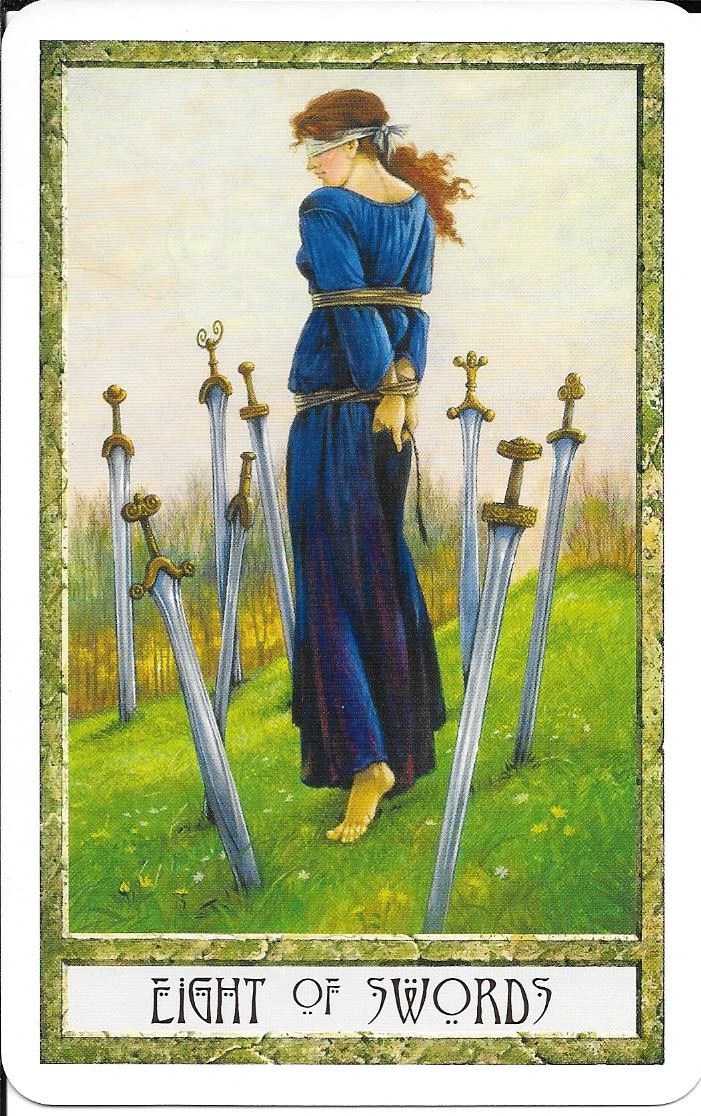
Nauthiz is a rune of constraint, hardship, or need. It gives one the feeling of being bound, i.e. being in a restrictive situation with little room to move. The Tarot card that comes to mind when I think of Nauthiz is the Eight of Swords which, traditionally, pictures someone bound by rope and blindfolded. They are surrounded by swords which are stuck into the ground. It’s not a hopeless situation. It simply calls us to take small, careful, deliberate steps in order to escape the difficulties we find ourselves in.
The positioning of Nauthiz in the Elder Futhark’s Second Aett confirms its meaning. Sandwiched in-between Hagalaz (hail) and Isa (ice), it is a rune that is surrounded by challenges on both sides. However, all is not lost since the hardships we face are often a catalyst for growth and transformation.
Druidcraft Tarot
My goal has always been to give an experiential interpretation of the runes on my blog rather than just regurgitate their meaning. So here’s how I see Nauthiz playing out in my life as we enter into the month of April. I had a number of health challenges in March that left me feeling sick and most of the time. My body was depleted and exhausted and my spirit wasn’t in much better shape.
This week, I finally feel like myself again and, yesterday I made a vow to do two things: 1) move every day, doing some kind of activity such as walking, yoga, etc. and 2) spend intentional time at my home altar meditating and doing energy work. These aren’t huge, life changing decisions but they will definitely help me to build up my strength, both physically and spiritually, and get me ready for the “next big thing.” My drawing of the Nauthiz rune today feels like Oðinn’s seal of approval that I’m on the right track. Small and stead steps are what I need to take at this point in my spiritual journey.
The rune poem I wrote to help me remember its meaning is as follows:
David Taliesin Rune Poem: NAUTHIZ can make someone feel bound But freedom can always be found. With careful steps and cunning mind A way forward you will surely find.
When I first began studying the runes, I read many different interpretations of both Uruz and Thurisaz. I had a hard time figuring out exactly how they spoke to me. While runes such as Fehu and Ansuz were crystal clear, the waters were a bit murky for Uruz and Thurisaz. Eventually I settled on the following interpretations of each of these runes. That being said, you will have to decide what they mean to you since you are the one who is interacting with them. My advice is to read as much as you can and trust your instinct regarding how they speak to you.
URUZ is a reference to the wild aurochs that used to roam the forests of prehistoric Europe. It was a formidable beast standing six feet at the shoulder with large forward-curling horns. If what I read is true, young men fought this beast as a test of their courage and strength. With this in mind, the keywords I associate with Uruz are “challenge, trial, rite of initiation, and test of strength that results in personal growth.”
When Uruz appears in a reading it tells me that there is a challenge you will have to face. This challenge will reveal what you’re made of and will require strength and courage on your part to defeat it. Think of it as a battle you need to wage or a rite of initiation you need to pass for your personal growth.
The rune poem I wrote to help me remember its meaning is as follows:
David Taliesin Rune Poem: URUZ the ox is wild and untamed, A formidable foe, a test of strength. Have courage when you face the beast. This leads to growth and victory.
In contrast to Uruz, Thurisaz is the giant who ransacks the village. Forget the soft Christianization of this rune as Thurnuz, meaning “thorn.” Thurisaz is a force to be reckoned with. The key words I associate with Thurisaz are “a hostile force that is undeserved or unfair, attack, danger, enemy ambush, chaos, blockage, disruption, and boundaries being threatened.” What is needed when the giant appears is defense, protection, reaction, and caution.
When Thurisaz appears in a reading, it’s a warning that trouble is coming your way that threatens to disrupt your life. Proceed with caution, knowing that you’ll need defensive weapons and protection to combat whatever is attacking you. Hold your ground and seek help from the Higher Powers who are more than willing to assist you. And above all, you need to remember that this attack is undeserved and unfair. You did nothing to deserve this!
The rune poem I wrote to help me remember its meaning is as follows:
David Taliesin (me) Rune Poem: The giant THURISAZ is headed your way, So stand your ground and muster your strength, Defend whatever you hold dear. Proceed with caution and have no fear!
Hope that helps. If you like, let me know how these two powerful runes speak to you.
For most people, St. Patrick’s Day is simply a day where we celebrate all things Irish, including the color green, shamrocks and drinking LOTS of Guinness. Americans go crazy for this secularized holiday and, according to an Irish friend of mine, make a bigger deal out of this holiday than they do in Ireland.
But not all is fun and games. According to some Pagans, St Patrick’s Day has a dark side. One of the most popular legends about St Patrick is that he drove out all the snakes from Ireland. However, according to The National Museum of Ireland in Dublin, there is no evidence that snakes ever lived in Ireland. This has led some Pagans to believe that “snakes” are a metaphor for Pagans, and view St. Patrick as the one who committed cultural genocide on the Celtic people.
Pitzl-Waters says “The simple fact is that paganism thrived in Ireland for generations after Patrick lived and died, and, as Lupus puts it, ‘the final Christianization of the culture didn’t take place until the fourteenth century CE’, there was no Irish pagan genocide, no proof of any great violent Druid purge in Ireland. It simply doesn’t exist outside hagiography. By the time hagiographers started speaking of snakes and Druids, Irish paganism was already a remnant, and Irish Christianity the dominant religious force on the island.”
I have also read that the Church designated St. Patrick’s feast day as February 17th to provide an alternative Christian holiday to the Pagan celebration of Ostara. I’m not sure this connection can be made either. history.com sets St. Patrick’s death date as February 17th. It may simply be a coincidence that the two holidays fall so close together.
As a final thought history.com offers the following positive info about St. Patrick and his relationship to Pagan culture. “Familiar with the Irish language and culture, Patrick chose to incorporate traditional ritual into his lessons of Christianity instead of attempting to eradicate native Irish beliefs. For instance, he used bonfires to celebrate Easter since the Irish were used to honoring their gods with fire. He also superimposed a sun, a powerful Irish symbol, onto the Christian cross to create what is now called a Celtic cross, so that veneration of the symbol would seem more natural to the Irish.”
Perhaps St. Patrick was not the geneocidal maniac some make him out to be, but he might not be 100% saint either. The jury is out on this one. You’ll have to draw your own conclusions regarding the origins of this Irish saint.
“Magick works , as long as you believe it works. If you can’t get your head around it at all, no amount of crystals or incense or oils will be able to make it work for you. You are the key to any spell or belief system that exists. You are the catalyst, you make it all happen.”—J.J. Green, Queer Paganism: A Spirituality That Embraces All Identities
Tiwaz is a powerful rune that is the first rune in Tyr’s Aett. I drew it the other day as I was facing several difficult challenges including a very sick dog. I was falling apart emotionally and this rune helped me to summon my inner warrior so I could fight for what my dog needed to hopefully get better. My dog needed me to be a calm, confident presence at his side and this rune helped me to be that for him.
Tiwaz is typically a rune of justice. For me, it speaks of fighting for what is good and right and true. Sometimes this involves sacrifice so we need to be prepared to lose something during the battle. It calls us to be brave and courageous as we summon our strength for whatever task we are called to do.
The story associated with this rune is the wolf Fenrir, son of Loki, who grew stronger every day. The gods worried Fenrir might become a danger to them so they devised a plan. They asked Fenrir if they could bind him in chains in order to test his strength. Fenrir agreed and broke through the chains easily. They did this a second time and Fenrir easily broke through those as well. The gods tried this a third time with special chains made by dwarves. but Fenrir grew suspicious. He agreed to the test if one of the gods was willing to play his hand in Fenrir’s mouth. Tyr was the only one to volunteer. The chains held and Fenrir bit of Tyr’s hand. Yet even with one hand, Tyr became known as one of the strongest and most courageous of warriors among the gods. That’s the kind of fortitude we’re talking about when Tiwaz appears.
It goes without saying that the times we are living in are perilous. Marginalized groups of people are being attacked in the United States with a ferocity I’ve never seen before. It’s time for all of us magical people to summon our Tyr energy and fight for what we know is just. Don’t be paralyzed with fear. Help whoever and wherever you can.
While studying the runes, I wrote a series to rune poems to help me understand their meaning. Here’s what I came up with for Tiwaz.
David Taliesin Rune Poem: When TIWAZ appears a battle is near, So fight for justice and have no fear. A warrior’s courage you must possess, With strength and courage you’ll find success.
Every once in a while you come across a book that you simply can’t put down. Such was the case for me with Queering the Runes: Reclaiming Ancestral Wisdom in Rune Magic & Mythology by Siri Vincent Plouff. I’ve read lots of rune books that are in circulation and most of them are just okay. This one immediately jumped into my top three list! It’s clear that Plouff knows their subject matter very well. Each page I read contained an insight that felt fresh and invigorating. I’ve been studying and working with runes for about two years now and I’m grateful for the opportunity to deepen my understanding of them.
The introductory material alone is worth the price of the book as Plouff takes the reader through a bit of their personal story, explaining queer terminology, a few observations regarding gender-bending by Oðinn and Loki, and confronting the white supremacy that has tried to hijack and misappropriate this beautiful magical tool. The book also explores the meaning of each rune as well as how to use them.
I have extensive notes on the runes in my personal Book of Shadows and I have most definitely added some of Plouff’s insights to it. This book is such a wonderful gift to those of us who work with the runes. You don’t need to identify as queer to read it. Allies to our community will also find it insightful and meaningful. I look forward to reading whatever project the author has in mind next. I have no doubt it will be wonderful!






 Sabbats and Sabbaths