
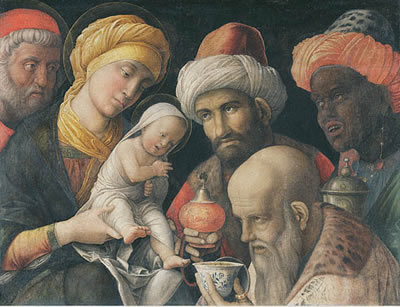
After the birth of Jesus at Bethlehem in Judea, in the reign of King Herod, some astrologers from the East arrived in Jerusalem, asking, “Where is the newborn king of the Jews? For we saw his star in the east, and have come to worship him.” When King Herod heard of this, he was much troubled, and so too was all Jerusalem. He called together all the chief priests and teachers of the Law in the nation, and questioned them as to where the Christ was to be born. “At Bethlehem in Judea,” was their answer, “for it is said in the prophet –’And you, Bethlehem in Judah’s land, are in no way least among the chief cities of Judah, for out of you will come a ruler—who will shepherd my people Israel.'”
Then Herod secretly sent for the astrologers. He found out from them the time of the appearance of the star. Sending them to Bethlehem he said, “Go and make a careful search for the child. When you have found him, bring word back to me, so that I, too, can go and worship him.” The astrologers heard what the king had to say, and then continued their journey. The star which they had seen in the east led them on, until it reached and stood over the place where the child was. At the sight of the star they were filled with joy. Entering the house, they saw the child with his mother, Mary, and fell at his feet and worshiped him. Then they opened their treasure chests, and offered to the child presents of gold, frankincense, and myrrh. But afterward, having been warned in a dream not to go back to Herod, they returned to their own country by another road. [Matt 2:1-12, OEB]
When dealing with Christian scripture my approach is to distinguish between two t’s. The little “t” is the historical truth of the story being told. The big “T” is the overarching truth of what the writer is trying to tell us. In the case of the story of the kings/magi/astrologers, it’s the big “T” that is more important.
As Matthew tells the story of the birth of Jesus, it’s interesting to note that his first worshipping community were foreigners whose spiritual path was different from Judaism. What do we know about them with what little information we have in the story? Many Bible translators render the Greek word MAGOI as either kings, wise men, or magi. MAGOI is probably best translated as magicians, astrologers or sorcerers. It is the name given by the Babylonians, Medes, Persians, and others, to the wise men, teachers, priests, physicians, astrologers, seers, interpreters of dreams, augers, soothsayers, sorcerers etc.
In the Arabic Gospel of the Infancy, the MAGOI are described as follows, “And it happened when the Lord Jesus was born in Bethlehem of Judea at the time of King Herod, the magicians arrived from the East in Jerusalem as Zoroaster predicted.” Essentially the MAGOI in Matthew’s story could have been followers of Zoroaster. If this is the case, they would have been from Parthia or Persia (now called Iran) whose primary religion was Zoroastrianism at the time. Zoroastrianism was a very old religion. It began about 6th or 7th century BCE by the prophet Zoroaster. It had its origins in a priestly caste of ancient Medes. Their religious leaders were seen as shaman or medicine men who specialized in the interpretation of dreams. Furthermore, the gifts of frankincense and myrrh that are mentioned in the story were commonly used during incantations and spells which lends credence to the possibility that the Magi were, indeed, medicine men from Persia.
I share this information with you because it puts a whole different spin on the story. They are not “we three kings of Orient are” as the well-known song goes. Instead, they are practitioners of magic, astrology, and dream interpretation which simply makes me smile. Jesus received them, and the holy family welcomed their gifts. Too bad so many Christians are hostile to other spiritual paths. The MAGOI are welcome in Matthew’s gospel so those who follow Jesus should do the same.
Epiphany blessings! Copyright ©2025 by David Taliesin, http://www.sabbatandsabbaths.com

 Sabbats and Sabbaths
Fantastic take on this subject! Thank you!
LikeLike
My pleasure. There is a lot more I could say but I try to keep my posts relatively short
LikeLike
My pleasure
LikeLike