
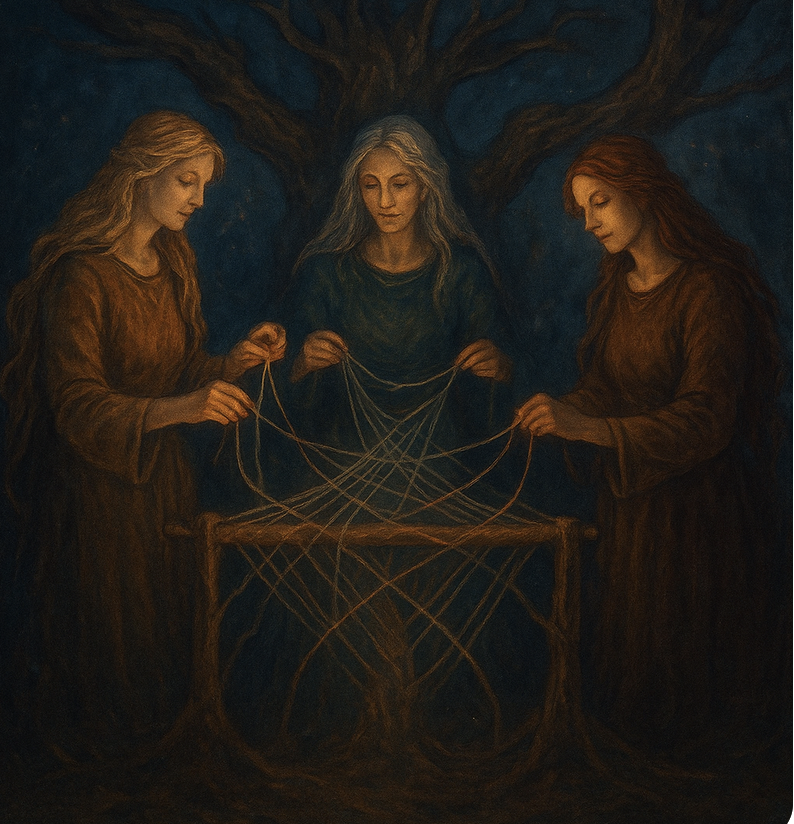
I’ve been reading Kveldulf Gundarsson’s Teutonic Magic: A Guide to Germanic Divination, Lore, and Magic, and came across an intriguing passage about the Old Teutonic concept of time:
“Perhaps the most notable difference between modern thought-patterns and those of the ancient Germanic people, which relates to the most essential theory of rune working, is the concept of time and being in relationship to time. Modern Western culture has absorbed the threefold Greco-Roman concept of time as ‘past’ (that which has gone before), ‘present’ (that which is), and ‘future’ (that which will be). It is easy to associate these concept with the three Norns Urdhr, Verdhandi, and Skuld. It is also incorrect. The Germanic time-sense is not threefold, but two-fold: time is divided into ‘that-which-is,’ a concept encompassing everything that has ever happened—not as a linear progression, but as a unity of interwoven layers—and ‘that-which-is-becoming,’ the active changing of the present as it grows from patterns set in that-which-is.”
This idea is completely new to me—I haven’t seen it discussed in other rune books. But I trust Gundarsson’s scholarship, and I believe it has the potential to change the way I read runes. This is especially true when I use the Three Norns spread. As a product of modern Western culture, I’ve always read them linearly—Past, Present, and Future—treating them as separate entities. Yet, if Gundarsson is right, they are more like interconnected branches of the world tree Yggdrasil. All three are bound together in ways we may not fully comprehend.
The Past doesn’t simply vanish. It remains with us in the Present, shaping our perception of reality moment by moment. Likewise, the Future doesn’t arrive out of nowhere. It grows from the trunk of our Past-Present selves. I know it may sound like something out of a science fiction novel, but it makes sense if I set aside my Western mindset for a while.
Beyond the runes, this two-fold view of time also has the potential to reshape my understanding of magic. I usually see magic as the channeling of Divine and natural energies toward whatever I’m trying to manifest. Yet Gundarsson’s perspective suggests it’s more profound than this. In working magic, I am also tapping into the power of the Ancestors. Their energy is not something that belongs only to the distant Past. It is alive with us in the Present, helping to shape the Future.
I need to sit with this for a while and see where it takes me. Have you encountered this two-fold concept of time before? If so, how has it influenced your own understanding of runes or magic? I’d love to hear your thoughts, as well as any book recommendations for further exploration.
Blessed be,
David Taliesin
Copyright, ©2025, David Taliesin, http://www.sabbatsandsabbaths.com

 Sabbats and Sabbaths
You may be interested in a book I’m now reading: The Spell of the Sensuous (David Abram). Sections of which he discusses time and space.
LikeLike
Thank you!
LikeLike