Rue: Herb of Grace

513UUOETyxL._SX300_

Rue is a hearty perennial and powerful herb with an interesting history. WRue is a hearty perennial and powerful herb with an interesting history. I grow one plant in my garden and, trust me, it’s more than enough so don’t plant a bunch of it! Wiccans use it for protection, cleansing and especially prosperity. Rue candles are often used in rituals to ask for financial or other assistance. One of my mentors, Byron Ballard, calls it “rocket fuel” and uses it to add zest to any kind of spell or energy work. One of the traditional prayers used in connection with this candle is quite beautiful:

My work is hard, but I’m strong and I do not complain
My rewards are few, but I treasure what I have
My needs are great, but my petitions are small
Asking only for what is just, I wait with quiet patience
Receiving in humble gratitude.

After this prayer is said, the petitioner states their specific need and then the candle is lit.

But Rue has other religious connections as well. It is also called “herb of grace,” or herbygrass and was But Rue has other religious connections as well. It is also called “herb of grace,” or “herbygrass” and was used in the early Roman Catholic Church to sprinkle holy water on the people during worship. In the Middle East Hyssop is traditionally used instead of Rue, but some believe Rue was used in Europe because it had antiseptic properties. This Roman Catholic custom may have been adapted from an ancient Roman ceremony where weapons, flags and the like were purified by waving a laurel branch over them.

The scientific name of this ancient herb is Ruta Graveolens. Ruta was the Latin name of the herb when the Romans introduced it to the English. It was eventually Anglicized to Rue. Graveolens is Latin for “a strong or offensive smell.” Personally, I think it smells just fine! I also like the flowers it produces which are small and delicate.

The way I make Rue Oil is very traditional. I pack a Mason jar full of sprigs and cover it with olive oil, making sure that no part of the plant is exposed to air. I then let it infuse for a moon cycle away from sunlight, strain, and use the oil for the rest of the year. I anoint most of my candles with it.

As a word of caution, Rue can be a dermatological irritant so it’s best to handle the plant with gloves on. I have never had an adverse reaction to Rue Oil but if you’re a person who is highly allergic you may want to avoid getting in on your fingers or try a small test patch on your arm and see what happens!!!

Copyright ©2022 by David Taliesin, http://www.sabbatsandsabbaths.com

Posted in Creation Spirituality, Herbology, Prayer | Tagged , | Leave a comment

Naming the Unnamable

Naming the Unnamable is a tricky proposition. Many ancient religions believed that if you knew the name of a god/goddess you could summon and/or control that deity. Thankfully, the Unnamable, the One who created all that is, refuses to be pinned down like this. When Moses asked the Unnamable for an ID, the response was “I Am Who I Am” (Ex 3:14). Jews call this the tetragrammaton and is composed of four Hebrew letters. They are transliterated into English as YHWH. Religiously observant Jews are forbidden to pronounce this “name” for the Unnamable. Most use either “Adonai” (Lord) of “Hashem’ (The Name) in its place. I also have Jewish friends who write G-D as a way of conveying the same thing.

The beauty of this is that the One who created all that is, remains a mystery and cannot be limited by such a small, earthly thing as a name. Furthermore, a scan through the Old Testament reveals that YHWH never appears in full form because humans could not handle it. Instead, Hashem reveals a little glimpse of the Divine in forms such as a pillar of could and a pillar of fire (Ex 13:21), the hem of a robe (Is 6:1), glory (Ex 16:10), and Hashem’s backside (Ex 33:23).

One of the biggest misconceptions about Pagan religions has to do with polytheism. Gus DiZerega, in Pagans and Christians: The Personal Spiritual Experience, says “Often people believe that polytheism implies denying the existence of a single source from which everything comes. Historically, it rarely has. A great many Pagan faiths acknowledge that there is an ultimate source for all that is, even while acknowledging other spiritual entities and powers with whom it is appropriate to relate.”

The Sioux Indians called the Unnamable “Wakan Tanka” which many translate as “The Great Spirit,” but it really means “The Great Mystery.” Some Wiccans refer to Drygthen which means “the original source of all things.” In the Gardnerian Drygthen Blessing Prayer, the following opening words describe the Unnamable: “In the name of Dryghtyn, the Ancient Providence, who was from the beginning and is for eternity, Male and Female, the Original Source of all things; all-knowing, all-pervading, all-powerful; changeless, eternal.” This doesn’t sound too far from the characteristics attached to YHWH in Judaism. [NOTE: I personally view YHWH as beyond gender so attaching male and female characteristics to the Great Mystery seems unnecessary.]

When it comes to Christianity, we have a mixed bag of references. Many Christians are attracted to Jesus’ Aramaic name for YHWH, “Abba.” It is a paternal term, meaning “Father,” or “Daddy.” Jehovah’s Witnesses prefer “Jehovah,” which is the Latinization of the Hebrew YHWH. It means “Self Existent” or “Eternal One.” Other Christians use “God,” “Creator,” and “Lord” which is used in many English Bibles for the Hebrew word YHWH.

So, we might be a bit closer to one another than we think! It seems like a spiritually healthy thing to keep the Unnamable unnamable. To think that we can grasp the Great Mystery who created everything that exists is pretty audacious on our part. The Unnamable is not going to be pigeonholed by even the smartest of us human beings. I wouldn’t have it any other way!

Copyright ©2022 by David Taliesin, http://www.sabbatsandsabbaths.com
Posted in Uncategorized | 1 Comment

Brigid Discernment Ritual

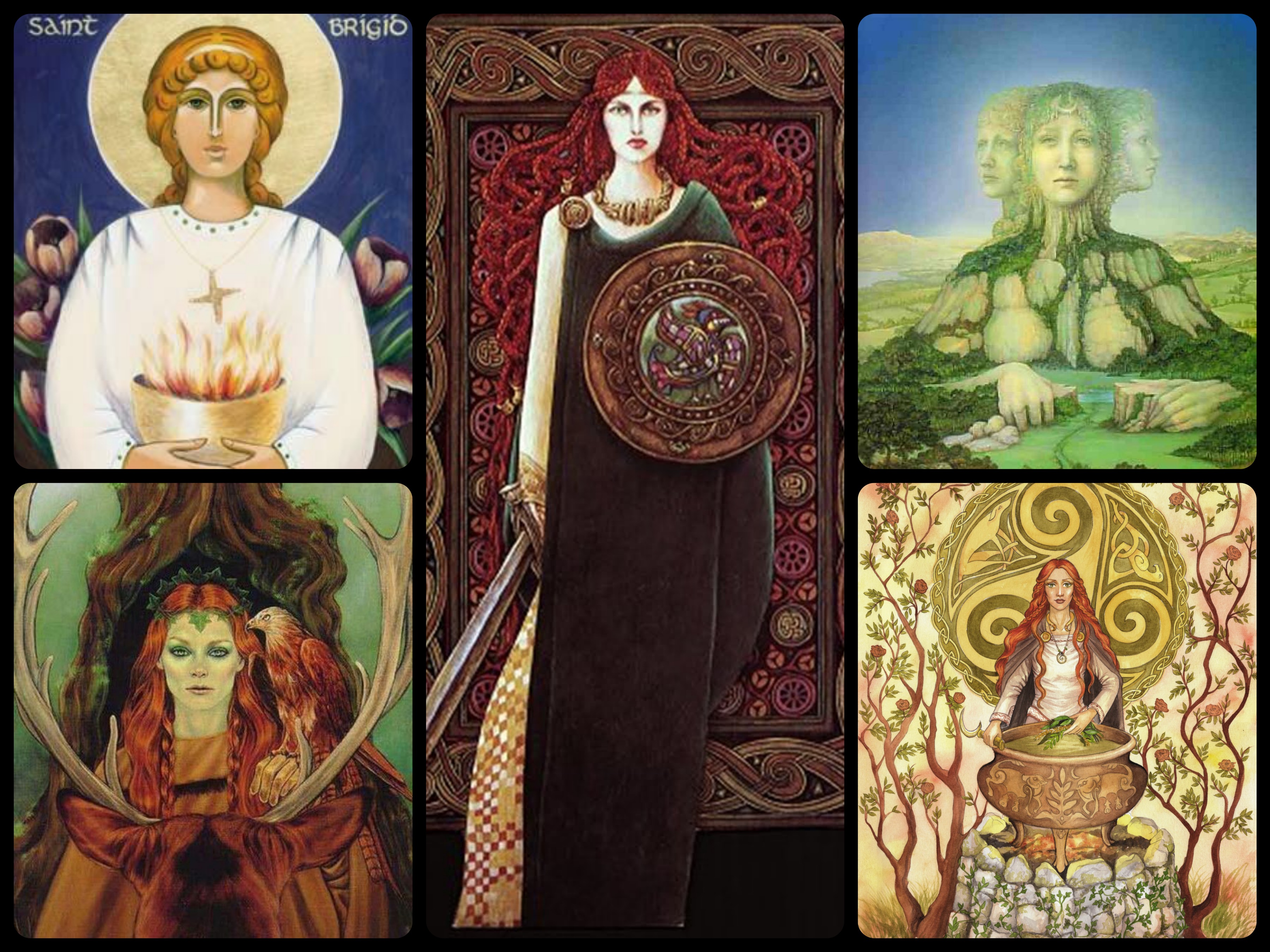
This was the closing ritual for one of Welcoming Circle’s Imbolc celebrations. It can be adapted for solitary practitioners. Images are from the Builders of the Adytum Tarot. I thought you might like to see it as we prepare for the celebration of Imbolc.

Here is the Brigid handout I gave to those who attended. Click Brigid Handout.

BRIGID DISCERNMENT RITUAL

ANOINTING WITH BRIGID OIL—David Taliesin
[Recipe for Brigid Oil is found in Cunningham’s Incense, Oils and Brews]

May Brigid, Keeper of the Sacred Flame,Give you wisdom and illumination tonight.

CANDLE LIGHTING—Traditional Gaelic. Light a white altar candle and say the following:

Brigid, Sublime Woman, Quick flame,
Long may you burn bright!
 You give us the invitation to life everlasting.

CALLING THE QUARTERS—from Llewellyn’s Sabbat Essentials, Imbolc: Rituals Recipes and Lore for Brigid’s Day + Brigid: History, Mystery and Magick of the Celtic Goddess

I summon the Powers of East—
Brigid’s bright powers of Dawn!
As you bring light to the Spring,
Bring light to our work.
Hail and Welcome!

I summon the Powers of South—
The blazing fires of Brigid’s Forge!
Shed all that does not aid our work!
Fortify our work! Let it change the world!
Hail and Welcome!

I summon the Powers of West—
The healing powers of the Well!
May our work flow and grow!
May it stir and summon the depths of possibilities!
Hail and Welcome!

I summon the powers of North—
The strength of the Cold Mountains!
Freeze all adversaries! Solidify our desires
With the weight of frozen rock!
Hail and Welcome!

Reach to the sky: By the Powers of the Fiery Arrows!

Reach to the ground: By the Powers of the Green Earth!

Extend your arms to your sides: Goddess Brigid, Goddess of Fire and Water,
We call you and invite you to the circle we have cast this night.

Goddess of the Sacred Well and Keeper of the Flame,
We ask that you bring your power and wisdom to this circle tonight.

Brigid, Goddess of the Forge, we honor you
And ask for your help and enlightenment in our work tonight.
Hail and welcome!

DISCERNMENT RITUAL—David Taliesin

Ground and center.

Connect with both the earth energy below and the Divine energy above. Let it fill your whole being until you feel like your body is full of light.

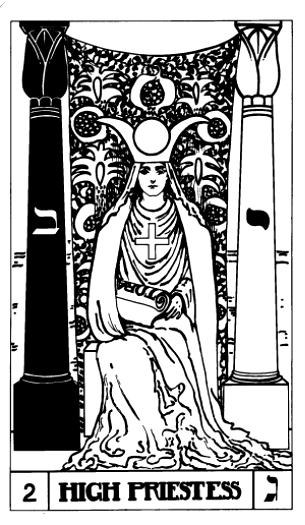
When you feel peaceful and focused, look at the Tarot Card image in front of you. Use it as an icon to center your thoughts and think about the work the Divine has called you to do. Record any thought that come to mind during this time of meditation. [I chose several images for participants to use from the wonderful black and white Builders of the Adytum Tarot. I offered the Fool, the Magician, the High Priestess, The Moon and Strength/Courage.]

When you are finished writing, take a tea candle and light it from the center pillar, and set it on the altar. Watch the flames of illumination grow as each person adds their candle to the altar.

Take a candle with you tonight, along with the image you selected. Use it in the coming weeks to further reflect on your calling/vocation.

BRIGID BLESSING
May my words be as considered as poetry,
May I reflect on all I do or say,
May I meditate on those things important spiritually
May I seek to know more of the lore
May I research what I am curious about
and what will enable me to grow
May I seek to know great knowledge,
May I acknowledge the intelligence of others
May I comprehend what I seek to learn and apply those lessons
May I know that seeking wisdom is not the same as being wise.
May I be a child of Brigid.
by https://elfkat.wordpress.com, Used by permission of the author.

DISMISSING THE CIRCLE—adapted from Llewellyn’s Sabbat Essentials, Imbolc: Rituals Recipes and Lore for Brigid’s Day + Brigid: History, Mystery and Magick of the Celtic Goddess

Great Brigid, Goddess of the Flame and Goddess of the Well,
We thank you for joining our magic circle tonight
And for the energy and wisdom you have bestowed upon us.
You will remain forever in our hearts!
We bid you farewell!

Farewell to the Powers of North—
As you came in peace, now go in peace,
But leave strength in our work.
Keep our adversaries in your icy grasp!
We bid you farewell!

Farewell to the Powers of West—
As you came in peace, now go in peace,
But leave your misty whispers on our work.
Wash away the obstacles to our manifestations!
We bid you Farewell!

Farewell to the Powers of South—
As you came in peace, now go in peace,
But leave your sparks of manifestation.
Allow the embers of our work to grow.
We bid you farewell!

Farewell to the Powers of East—
As you came in peace, now go in peace.
Though the day passes, the work of the sun remains.
Remain also with our work.
We bid you farewell!

The circle is open but never unbroken
Because it is a circle woven in love.
Whatever energy is left in this space
We return to the earth with a spirit of gratitude.
Merry meet and merry part, and merry meet again.

As noted, portions of this ritual were written by David Taliesin, ©2022, http://www.sabbatsandsabbaths.com

Posted in Brigid, Imbolc, Magic, Spirituality, Tarot | Leave a comment

Our Spiritual Practice

I’ve reached the point in my spiritual journey where I have little patience for arguments and debates about the right way to do spirituality. Instead, I find it much more profitable to listen to spiritual voices and perspectives that are quite different from my own. If we are secure in our spiritual path, we don’t need to fear other perspectives. They hold the potential of moving us out of our spiritual comfort zones and helping us to grow.

Gus DiZerega. in his insightful book Pagans and Christians: The Personal Spiritual Experience, states it this way: “The value of a spiritual practice is determined by how well it brings us into a better relationship with what is Highest and most Sacred. If our spiritual practice does not help us in this task, it is not really important how many debates we win, how subtle our thinking, or how profound our insights. All these things, desirable as they can be, are simply icing on the spiritual cake. When the cake is good, the icing adds to its beauty and flavor. When the cake is bad, the icing is only a deceptive promise. So our personal practice within and without our spiritual community is primary.”

Copyright ©2022 by David Taliesin, http://www.sabbatsandsabbaths.com (Not the quote but the first paragraph of this post.)

Posted in Spirituality | Tagged , | Leave a comment

The Power of Meditation

dreamstime_8683396

Meditation is a form of prayer that transcends religious divisions. Both Christians and Wiccans have found solace and power in this form of prayer. Scott Cunningham, in Wicca: A Guide for the Solitary Practitioner, says “It’s a quiet time in which we commune with the Goddess, the God, and ourselves, relaxing the conscious mind’s hold on our psychic awareness. Meditation usually precedes every magical act and rite of worship.” Many Wiccans I know practice this regularly in order to learn how to focus their attention and keep their “monkey mind” (A Buddhist term) from jumping all over the place.

The seminary I attended never spoke of meditation. I first learned how to do it from a Buddhist teacher who also taught me about the practice of mindfulness. Then I discovered the writings of the Christian mystics who are a marginalized voice in Christianity. I spent about year and a half pondering the words of mystics such as Meister Eckhart, The Desert Fathers and Theresa of Avila. I got excited with every page I read because I found my people. They were my guides, my spiritual siblings, and I’ve valued their wisdom ever since.

With respect to the subject of meditation, Meister Eckhart states it best, “God is not found in the soul by adding anything, but by a process of subtraction.” 15th Century monk Thomas a Kempis, in The Imitation of Christ, said “The further the soul is from the noise of the world, the closer it may be to its Creator, for God, with his holy angels, will draw closer to a person who seeks solitude and silence.”

Meditation is one of the bridges that connects our two traditions together. I know people in both traditions who don’t practice it regularly, but I believe they are missing out on a great tool for spiritual growth and getting in touch with the Divine. Our world is filled with too many words. When we are brave enough to be silent, we allow the Holy to get a word in edgewise!

Copyright ©2021, by David Taliesin, http://www.sabbatsandsabbaths.com
Posted in Meditation, Prayer, Spirituality | Tagged , , , , | Leave a comment

Our Spiritual Path

theway

Before the word “Christian” was used, followers of Jesus were known as “The Way” (Acts 9:2, among others). The Greek word used here can also be rendered as “the road” or “the journey.” Early Christians understood they were on a path with lots of twists and turns, ups and downs. The journey never had an endpoint when believers were finished with their spiritual development. The goal was to keep evolving and growing in love, compassion, service, etc.

Somewhere along the line, The Way became a million denominations with endless rules and doctrines. Many of these denominations also claim to be the only “way” or path. If we don’t believe everything they believe exactly as they believe it, we’re on a slippery slope to hell! Needless to say, this is an unhealthy way to do spirituality.

All human beings, whether they know it or not, are on a spiritual path where we see and experience many different things along the way. The ones that work for us should be put in our spiritual backpacks. The rest should be left at the side of the road. It’s a much more individualistic quest than many people think it is. Furthermore, there is no getting it right. We are on a journey of learning and growth that’s supposed to continue throughout our lifetimes.

Thankfully, Wiccans have a healthier approach to “the way.” For the most part, they are not dogmatic at all, at least the ones I know. (I’m sure there are some out there who are vey dogmatic. People are people!) They encourage each other to experiment and discover what works for them. Some lead lives of deep meditation and centering. Others have vast knowledge of herbs and their medicinal purposes. Some have gifts of discernment, while others are gifted healers. Many, of course, are a combination of the above…and so much more!

Scott Cunningham in his classic book Wicca: A Guide for the Solitary Practitioner states this beautifully: “There is not, and can never be, one ‘pure’ or ‘true’ or ‘genuine’ form of Wicca. There are no central governing agencies, no physical leaders, no universally recognized prophet or messengers. Although specific, structured forms of Wiccan certainly exist, they aren’t in agreement regarding ritual, symbolism, and theology. Because of this healthy individualism, no one rite or philosophical system has emerged to consume the others. Wicca is varied and multi-faceted. As in every religion, the Wiccan spiritual experience is one shared with the deity alone.”

Perhaps this is a reminder that we are all on “the way.” There is no single, perfect way to walk it. If we humans can learn to listen to one another more and judge less, we just evolve as a species.I believe we have a lot to teach each other if we’re willing to walk hand in hand down the road. Le’’s share our wisdom and gifts. The world needs all the light and love both traditions can bring to it!

Copyright 2022 by David Taliesin, http://www.sabbatsandsabaths.com.

Posted in Spirituality | Tagged , , , , | 1 Comment

The Problem With Genesis

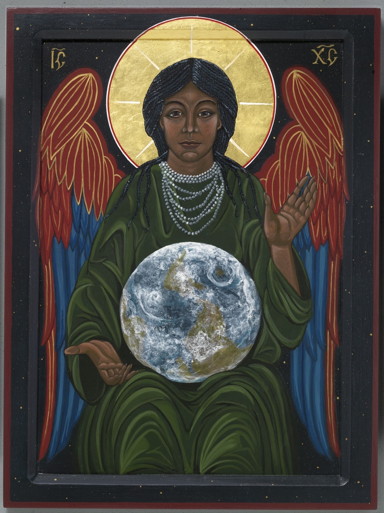
"Sophia" by Mary Plaster, www.maryplaster.com/sophiadivinewisdom.html
Sophia, Divine Wisdom by Mary Plaster, http://www.maryplaster.com

Christianity has a problem when it comes to creation spirituality, and that problem begins with Genesis. As a disclaimer, I understand the story of Genesis 1 to be, well, a story. It contains Truth, but it’s not historically true. Rabbis for centuries have understood it to be a fable/legend about our relationship with the Divine and I understand it the same way.

Here’s the rub. Most of the story is beautiful and dynamic. The RUAH or spirit of God (which is feminine by the way) breathes/blows/flutters its wings, creating a disturbance in the darkness, and light is born. Everything else such as the sun, moon, animals, fish and humans follow. It’s actually quite moving and poetic.

The problem arises when we get to verse 28 (26 isn’t any better): “God blessed them, and God said to them, ‘Be fruitful and multiply, and fill the earth and SUBDUE it; and have DOMINION over the fish of the sea and over the birds of the air and over every living thing that moves upon the earth.” Oy, veh!

Rabbis and Christians alike have always tried to spin this verse in positive ways. The brilliant Rabbi Richard Freidman in his commentary on the Torah, says “Incredibly some have interpreted this command to mean that humans have permission to abuse the earth and animal and plant life—as if a command from God to rule did not imply to be a good ruler!” Personally, I would like to think he is right, but it might be stretching things a bit.

Brown Drivers Briggs Hebrew and English Lexicon, which is the gold standard for unpacking Hebrew words says that SUBDUE (Heb. KABASH) means “dominate, tread down, or bring into bondage.” Likewise DOMINION (Heb. RADAH) means to “rule, dominate, tread, or trample.” What’s a tree-loving Christian to do?

Thankfully, my Wiccan sisters have shared with me some of their spiritual practice which is deeply tied to nature. While I’m hardly an expert on the subject, this path includes a profound appreciation for all living things and their relationship with one another. Furthermore, the Wheel of the Year takes its clues from the changing seasons and many Wiccans have an amazing knowledge of herbs, gems and other organic life.

Christians have got to get over their fear and suspicion of our Pagan sisters and brothers because they have great wisdom to share with us regarding our relationship to creation, if we open our minds to it. This doesn’t mean we need to follow the Wiccan path; but it does mean we need to find a way to integrate creation spirituality into our Christian practice. Thankfully, there are already people around us who do this so effortlessly and beautifully. It’s time for us to have “ears to hear” and “eyes to see” as we overcome the exploitive language of Genesis 1.

Copyright ©2022 by David Taliesin, http://www.sabbatsandsabbaths.com.

Posted in Creation Spirituality | Tagged , | 3 Comments

Golden Rule and Wiccan Rede

wiccanrede

Nearly every faith tradition in the world has some variation of the Golden Rule, which is usually stated “Do unto others, as you would have them do unto you.” In the Christian tradition, it is found in Matthew 7:12 “In everything do to others as you would have them do to you; for this is the law and the prophets,” and Luke 6:31 “Do to others as you would have them do to you.” Jesus implies that all of Jewish Law is fulfilled by this one ethical statement. He would also go on to reformulate the Golden Rule by saying that two commands fulfill Jewish Law: 1) Love God with all your heart, soul and mind, and 2) Love your neighbor as yourself. (See Mt 22:37, Mk 12:30 and Lk 10:27)

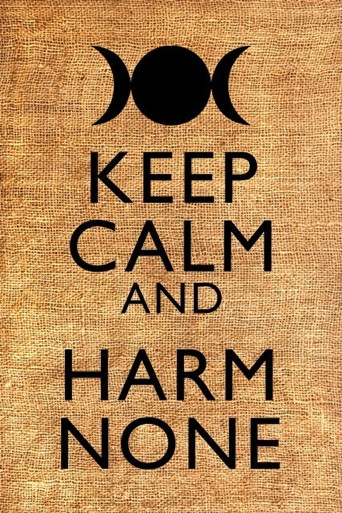
The Pagan version of the Golden Rule is known as the Wiccan Rede. The word “rede” is Middle English and means “advice” or “counsel.” It is the ethical touchstone of many of those who practice Wicca and goes like this: “An it harm none, do what ye will.” NOTE: “an” is Middle English for “if.”

The Golden Rule and the Wiccan Rede seem simplistic, but they’re not. The practical application of this moral law takes a lot of serious thought. In Jesus’ form of the “love commandments,” one must ask themselves “Are my words and actions bringing me closer to the Divine and my neighbor, or are they having the opposite effect?” Another consideration is if we don’t love and accept ourselves, how can we possibly love the Divine and our neighbor fully?”

With respect to the Wiccan Rede, the first question Wiccans need to ask themselves is “What does harm mean?” Sometimes we need to show people tough love in order for them to heal. They may feel like we are harming them, but, in the end, it’s for their own good and benefit.

The second part of the Rede “do what ye will” is hardly a call for hedonism and self-indulgence. “Doing harm to no one” also means we are to do no harm to ourselves. A Wiccan friend of mine recently said “Wicca demands self-awareness, self study and connection to spirit.” The question this part of the Rede raises is “What is your life’s purpose? What does your soul want out of this lifetime?”

So both traditions connect strongly with this moral guideline. Both spiritual paths ask us to think deeply about who we are and how we impact our neighbors and our planet.

Copyright ©2022 by David Taliesin, http://www.sabbatsandsabbaths.com

Posted in Spirituality, Wiccan Rede | Tagged , , , | Leave a comment

Time Keeps On Ticking

People mark time in different ways. Some of us carry a physical calendar with us to keep track of events and appointments. Others use a virtual one on our cell phones. Some have four seasons and all the delightful changes each one brings. Others live in a temperate climate all year round and have to watch for subtler changes in nature that tell us what time of year it is.

Not surprisingly, our spiritual lives are structured in ways that mark time as well. Both Pagans and Christians have rites that celebrate significant life events such as birth, coming of age, marriage, death, etc. Then there are the “spiritual calendars” both groups keep that take us through the cycle of the year. Not surprisingly, both of these calendars connect with one another in significant ways.

Most modern Pagans follow the “Wheel of the Year” which is an annual cycle of eight seasonal festivals. Wiccans call these sabbats (from the Greek word “sabatu” which means “to rest.”)

Wheel_of_the_Year


Four of the sabbats fall on the solstices and equinoxes of the year and are referred to as “quarter days.” They include Yule, Ostara, Midsummer, and Mabon. The other four occur on the midpoints between the other four and are referred to as “cross quarter days.” They include Imbolc, Beltane, Lughnasadh and Samhain. All of these sabbats are deeply tied to the cycle of the seasons in the Northern Hemisphere. These sabbats are rich with agricultural and natural imagery where the change of seasons reflect various aspects of our spiritual lives such as rebirth, growth, maturity, and dormancy.

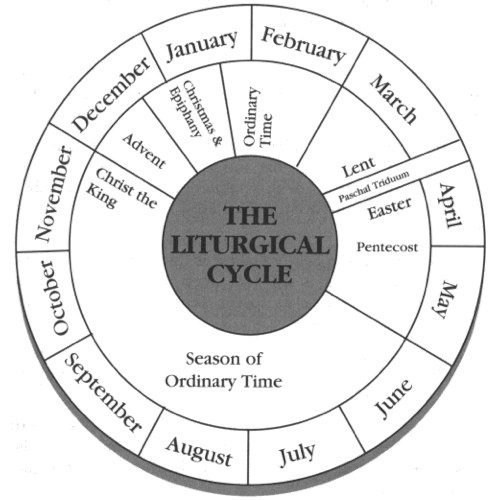
Many modern Christians follow the “Liturgical Calendar” which, surprise, surprise, is also in the shape of a wheel! This calendar follows mostly follows the life of Jesus and contains the seasons of Advent. Christmas, Epiphany, Lent, Easter and Ordinary Time. While Advent always begins four Sundays before December 25th, Easter is a moveable feast that occurs on the first Sunday after the Paschal Full Moon, falling on or after the Spring Equinox (March 21). Once the date for Easter is established, then the days of Lent through Pentecost fall into place.

liturgical-calendar


I see several very deep connections between these two ways of marking spiritual time. For Christians, Advent is a season of waiting for the light to appear, that light being Jesus whose actual birth date is unknown. December 25th was chosen because it coincided with other Pagan celebrations surrounding the winter solstice such as the Roman Saturnalia and the Pagan Yule. Both of these observances are also festivals of light and the connection between these and the themes of Advent and Christmas are too numerous to mention in this post.

The second big connection is that the Lent/Easter season traces Jesus’ death and resurrection. Its most powerful spiritual theme is dying to destructive ways of living and rising to new life. This fits perfectly with the themes of Imbolc (which speaks of seeds dying and rooting/transforming so that new life can emerge in the spring) and Ostara (which is all about fertility, birth and the new life that is blooming everywhere).

Well, that gets us started. Both of these spirituals calendars are powerful ways of thinking about our ives and our connection with the Divine and each other.

Copyright ©2022 by David Taliesin, http://www.sabbatsandsabbaths.com.

Posted in Advent, Beltane, Christmas, Easter, Epiphany, Imbolc, Lent, Liturgical Calendar, Lughnasadh, Mabon, Midsummer, Ostara, Samhain, Wheel of the Year, Yule | Tagged , | 5 Comments

Frankincense: Universal Magical Resin

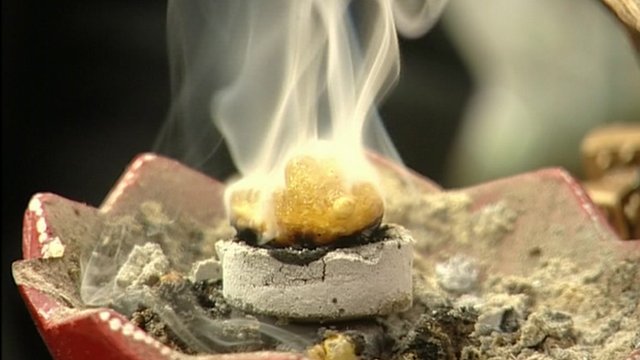
frankincense

The LORD said to Moses: Take sweet spices, stacte, and onycha, and galbanum, sweet spices with pure frankincense (an equal part of each), and make an incense blended as by the perfumer, seasoned with salt, pure and holy; and you shall beat some of it into powder, and put part of it before the covenant in the tent of meeting where I shall meet with you; it shall be for you most holy. [Ex 30:34-36, NRSV]

On entering the house, they saw the child with Mary his mother; and they knelt down and paid him homage. Then, opening their treasure chests, they offered him gifts of gold, frankincense, and myrrh. [Mt 2:11, NRSV]

Many years ago, I had the wonderful opportunity to tour Egypt. One of the stops in the Valley of the Kings was a perfume factory that manufactures essential oils. I smelled a number of scents that day but the one that immediately became my favorite was frankincense. I loved its spicy, musky scent and purchased a sizable bottle of the stuff to bring back home. My favorite use of it is on Christmas Eve. After worship, I offer those who attend the service the chance to be anointed with it. Very few say no. There is something magical about the scent that’s irresistible! I’m also glad to report that of the thousands of people who have been anointed with it over the years, not a single one had an allergic reaction to it that I’m aware of.

Frankincense is native to both North Africa and the Arabian Peninsula. It has been cultivated for over 5,000 years and was used as incense by ancient Pagans in Persia, Babylon, Egypt, Greece and Rome. Eventually both Jews and Christians incorporated this fragrant resin into their worship life as well, making frankincense the universal resin that ties us all together! Jews used it as part of a special blend of incense that was burned in both the tabernacle and the Temple. The exact formulation of this incense is up for debate but there’s no doubt that frankincense was a part of it. Frankincense was also among the gifts given to the Christ Child by the “Magi” (i.e. the magicians) who, according to the Arabic Gospel of the Infancy, were followers of Zoroaster. To this day, frankincense is used in many Christian churches, especially Roman Catholic, Orthodox, Episcopalian and Lutheran. It is also heralded in the popular Christmas carol We Three Kings:

Frankincense to offer have I; incense owns a Deity nigh.
Prayer and praising, gladly raising, worshipping God, Most High.
O, star of wonder, star of night, star with royal beauty bright;
Westward leading, still proceeding, guide us to thy perfect light.

Frankincense is also called olibanum and the English name of this resin comes from the Old French “franc encens,” which simply means “high quality incense.” Among Wiccans, it’s planetary correspondence is Sun and it’s elemental correspondence is Fire. Magical properties include protection, exorcism, spirituality, cleansing, consecration and purification. It is believed that when frankincense is burned it releases powerful vibrations which not only lift up those in the area, but also drive out all evil and negativity. It is also burned to induce visions and to aid meditation. According to Scott Cunningham it is easily substituted with copal or pine resin. (I’m allergic to pine so this is not an option for me!) Frankincense is a little hard to grind into a powder with a mortal and pestle but be patient and you’ll get the hang of it!   The oil is useful in promoting spirituality and meditative states.

When I am doing any magical work that requires an extra boost, I use the following incense blend which is an adaptation of a formula from Scott Cunningham’s indispensable volume “The Complete Book of Incense, Oils & Brews.” This Ares Blend works like rocket fuel for me!

2 parts Frankincense (Sun, Fire)
1 part Juniper berries (Sun, Fire)
1 part Cedar leaf tips (Sun, Fire)

I grind these ingredients with a mortal and pestle as best as I can and place them on a self-lighting incense charcoal briquette. When working with Frankincense it should be noted that it often emits a bitter aroma the longer it burns. For this reason, some prefer to use Copal in its place which stays sweet from start to finish. Copal is also native to North America so it’s the perfect choice for those who live on this continent and feel strongly about using plants and resins that are native to their region.

As a final note, Witchipedia says that “recent studies have indicated that frankincense tree populations are declining, partly due to over-exploitation. Heavily tapped trees produce seeds that germinate at only 16% while seeds of trees that had not been tapped germinate at more than 80%. In addition, burning, grazing, and attacks by the longhorn beetle have reduced the tree population. Conversion (clearing) of frankincense woodlands to agriculture is also a major threat.” Because of this, take the time to find out where the frankincense you’re purchasing comes from. My local metaphysical bookstore sells frankincense resin which comes from a company that is dedicated to harvesting it sustainably. It might be a little more expensive but it’s worth the extra cost in my book.

Copyright ©2021 by sabbatsandsabbaths.com

Posted in Incense | Tagged , | 2 Comments