Spirituality Types, Part 1

One of the reasons we have such a hard time understanding each other as human beings has to do with our “spirituality types.” Each of us, Pagan or Christian, experiences Divine in many different ways. Think of it as two intersecting lines:

The VERTICAL LINE is the difference between those who connect with Spirit better through the MIND verses those who connect with Spirit better through the HEART.

The goal of MIND is to “know the Divine.” Faith is more of an intellectual experience for them and they tend to get more out of sermons, bible studies, and practical applications of the their spiritual practice.

The goal of HEART is to “sense the Divine.” Faith is more of an emotional experience for them and they tend to get more out of prayer, music and the spirit of worship/ritual action.

Everyone fits somewhere along this vertical line. Some are stronger toward the MIND…others stronger towards the HEART.

Think for a moment about where you are on this line.

spiritualitychart

The HORIZONTAL LINE is the difference between those who experience Spirit more as MYSTERIOUS and HIDDEN verses those who experience Spirit more as PRESENT and REVEALED.

The Difference between these two types is the MYSTERY group tends to think of the Divine in terms of being powerful and almighty. The Divine is out there somewhere, a little distant and mysterious; perhaps a little hard to get to know.

The REVEALED group tends to think of the Divine as being up close and personal.  The One who walks with you and talks with you. The One who is always present with you every moment of the day.

Everyone also fits somewhere along this horizontal line. Some are stronger toward the MYSTERY…others stronger towards REVEALED.

Think for a moment about where you are on this line.

In the end, this puts us in one of four quadrants I will talk about in tomorrow’s post. Each of the four quadrants experiences the Divine a little bit differently. The challenge comes when we think our quadrant is the only “right way” to experience the Divine. This is absolutely NOT the case! The goal for all of us as we continue in our spiritual path is to move closer toward the center of the graph. Having a balance of all four of these perceptions enables us to appreciate the spiritual experiences of others. We are also much less threatened by others whose spiritual experiences can be quite different from ours.

Copyright ©2016 by David Taliesin, http://www.sabbatsandsabbaths.com

Posted in Spirituality | Tagged , , | 1 Comment

Meditation Exercise: Soul Sweeping

meditation_sun

This is a simple meditation exercise I’ve used with people of all spiritual traditions. I use it myself when I feel the need to let go of something I’ve been holding onto for way too long.

BREATH PRAYER [SOUL SWEEPING]

1. Choose a set of opposite words that represent something you would like more of and something you would like less of in your life. Ex. love/hate, peace/worry, hope/despair, light/darkness, healing/sickness, contentment/envy, faith/doubt, calm/fear, etc.

2. Then close your eyes. Sit still and upright, relaxed and alert.

3. Focus on your breathing. With each exhale let your body relax more deeply.

4. When you are ready with each inhale say “Breathe in love” or whatever word you have chosen. Imagine the breath as well as the feelings associated with the word coming through the top of your head and filling your body. As you exhale say “Breathe out hate” or whatever word you have chosen. Imagine the breath as well as the feelings associated with the word exiting your body through your feet.

Copyright ©2016 by David Taliesin, http://www.sabbatsandsabbaths.com

Posted in Meditation, Prayer, Spirituality | Tagged , , , , | Leave a comment

Naming the Unnamable

YAHWEH_blue_sm1Naming the Unnamable is a tricky proposition. Many ancient religions believed that if you knew the name of a god/goddess you could summon and or control that deity. Thankfully, the Unnamable, the One who created all that is, refuses to be pinned down like this. When Moses asked the Unnamable for an ID, the response was “I Am Who I Am”  (Ex 3:14). Jews call this the tetragrammaton and is composed of four Hebrew letters. They are transliterated into English as YHWH. Religiously observant Jews are forbidden to pronounce this “name” for the Unnamable. Most use either “Adonai” (Lord) of “Hashem” (The Name) in it’s place. I also have Jewish friends who write G-D as a way of conveying the same thing.

The beauty of this is that the One who created all that is, remains a mystery and cannot be limited by such a small, earthly thing as a name. Furthermore, a scan through the Old Testament reveals that YHWH never appears in full form because humans could not handle it. Instead, Hashem reveals a little glimpse of the Divine in forms such as a pillar of could and a pillar of fire (Ex 13:21), the hem of a robe (Is 6:1), glory (Ex 16:10), and Hashem’s backside (Ex 33:23).

One of the biggest misconceptions about Pagan religions has to do with polytheism. Gus DiZerega, in Pagans and Christians: The Personal Spiritual Experience, says “Often people believe that polytheism implies denying the existence of a single source from which everything comes. Historically, it rarely has. A great many Pagan faiths acknowledge that there is an ultimate source for all that is, even while acknowledging other spiritual entities and powers with whom it is appropriate to relate.”

The Sioux Indians called the Unnamable “Wakan Tanka” which many translate as “The Great Spirit,” but it really means “The Great Mystery.”  Some Wiccans refer to Drygthen which means “the original source of all things.“  In the Gardnerian Drygthen Blessing Prayer, the following opening words describe the Unnamable: “In the name of Dryghtyn, the Ancient Providence, who was from the beginning and is for eternity, Male and Female, the Original Source of all things; all-knowing, all-pervading, all-powerful; changeless, eternal.” This doesn’t sound too far from the characteristics attached to YHWH in Judaism. [NOTE: I personally view YHWH as beyond gender so attaching male and female characteristics to the Great Mystery seems unnecessary.]

When it comes to Christianity, we have a mixed bag of references. Many Christians are attracted to Jesus’ Aramaic name for YHWH, “Abba.” It is a paternal term, meaning “Father,” or “Daddy.”  Jehovah’s Witnesses prefer “Jehovah,” which is the Latinization of the Hebrew YHWH. It means “Self Existent” or “Eternal One.” Other Christians use “God,” “Creator,” and “Lord” which is used in many English Bibles for the Hebrew word YHWH.

So, we might be a bit closer to one another than we think! It seems like a spiritually healthy thing to keep the Unnamable unnamable. To think that we can grasp the Great Mystery who created everything that exists is pretty audacious on our part. The Unnamable is not going to be pigeonholed by even the smartest of us human beings. I wouldn’t have it any other way!

Copyright ©2016 by David Taliesin, http://www.sabbatsandsabbaths.com

Posted in Prayer, Spirituality | Tagged , | 1 Comment

Season of Creation

SOC_logo_shadowFor those who belong to Christian faith communities, I have an interesting resource for those who are looking for an alternative to the Revised Common Lectionary (a three year series of appointed readings for worship). The Season of Creation is celebrated during the four Sundays in September prior to St Francis of Assisi Day (October 4). The sequence of readings for this season creates a liturgical pattern similar to that in the season of Advent. The readings are designed to provide a three-year cycle corresponding broadly to the years of Matthew, Mark and Luke in the Revised Common Lectionary.

The sequence of readings in each series follows a broad pattern of creation, alienation, passion and new creation. The readings also give special attention to the story of Earth, which complements the story of God and the story of humanity in the Scriptures.

In 2016 we will be in Series C: Wisdom in Creation:

Sept 1—Creation Day
Sept 4–1st Sunday in Creation: Ocean Sunday
Sept 11–2nd Sunday in Creation: Fauna and Flora Sunday
Sept 18–3rd Sunday in Creation: Storm Sunday
Sept 25–4th Sunday in Creation: Cosmos Sunday
Oct 2—St Francis of Assisi Day: Blessing of the Animals

There are tons of resources on the web site http://www.seasonofcreation.com that can be used as a part of this new liturgical season or as stand alone materials for worship. Some of the liturgies are beautiful and breath-taking and I am particularly fond of a new hymn text entitled Song of the Waters by Norman Habel. The Season of Creation began in the Lutheran Church in Australia but is now used by denominations across the globe.

Song of the Waters

Watch once more the windswept storm clouds;
Suddenly the sky has wings!
God has come to rain among us,
Giving hope to all dry things.
Sing a song of splashing waters,
Pulsing through the veins of Earth.

Taste the moisture of the morning,
Smoother than the best red wine;
Toast the lifeblood of the planet:
Here’s to God’s wild wet design!
Sing a song of flowing waters,
Pulsing through the veins of Earth.

View anew the dark blue ocean,
Whales cavorting, spraying foam;
God at play with deep sea monsters,
Feeling very much at home.
Sing a song of laughing waters,
Pulsing through the veins of Earth.

Feel the breath of God move softly,
Gentle mists that brush the skin;
Earth is breathing God’s own spirit,
Life renewed from deep within.
Sing a song of living waters,
Pulsing through the veins of Earth.
Words: © Norman Habel 2001
Melody: Praise my Soul the King of Heaven

Posted in Creation Spirituality, Jesus, Liturgical Calendar | Tagged , , , , | Leave a comment

Rose: Love Is In The Air!

Lo, how a Rose e’er blooming from tender stem hath sprung!
Of Jesse’s lineage coming, as men of old have sung.
It came, a floweret bright, amid the cold of winter,
When half spent was the night.
Traditional German Carol, late 1500’s

There is no rose of such virtue
As is the rose that bear Jesu; Alleluia.
Traditional English Christmas Carol, c.1420

roseprintIs there any other flower that has been heralded as much as the rose? According to Witchipedia, “roses have been cultivated for over 5,000 years. There are 150 natural named species worldwide and thousands more cultivars. The Chinese were the first to cultivate roses and begin hybridizing them.”  The rose, which has always been a symbol of love, may be the one flower that transcends all cultural and religious boundaries. It’s magical, medicinal, culinary and decorative uses have been appreciated by just about everyone. If you find someone who hates roses, you might want to keep your distance from them!

In Pagan circles, the rose has been tied to a number of deities, especially Aphrodite, the goddess of love and beauty. In ancient Rome, the rose was associated with Venus, Bacchus and Cupid. According to A Modern Herbal, the Romans viewed “the rose as a sign of pleasure, the companion of mirth and wine, but it was also used at their funerals.”

As a ritual and magical flower, rose petals and rose hips are often used in connection with love and healing spells. Rose water is used in baths to enhance the mood for love. Rose tea is said to enhance prophetic dreams and their scent has a calming effect as well. And let’s not forget how many people send roses to convey love, friendship, sympathy and the like.

Christians also have a long association with the rose. During the Middle Ages the rose was cultivated in monastery gardens and was used for medicinal purposes. Medieval Christians identified the five petals of the wild rose with the five wounds of Christ. The red rose also stood for the blood and suffering of Jesus and was eventually adopted as a symbol of the blood of the Christian martyrs as well. The rose also has a long association with the Virgin Mary, especially a white one which stands for purity, virtue and unselfish love.

lutheran roseDuring the Protestant Reformation, Martin Luther designed the Luther Rose or Luther Seal whose central image is that of a red heart on top of a white rose. He said, “Such a heart should stand in the middle of a white rose, to show that faith gives joy, comfort, and peace. In other words, it places the believer into a white, joyous rose, for this faith does not give peace and joy like the world gives. That is why the rose should be white and not red, for white is the color of the spirits and the angels.”
There is so much more that can be said but there is no doubt that the rose has been a powerful symbol and magical flower for a very long time.  Enjoy them!

Copyright ©2016 by David Taleisin, http://www.sabbatsandsabbaths.com

Posted in Herbology | Tagged , , , , , | Leave a comment

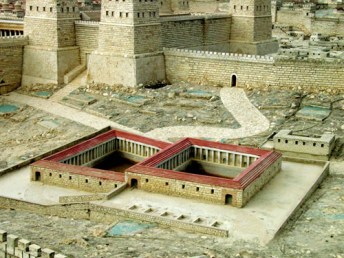
A Holy Pool For Everyone: Bethesda

poolofbethesda

Model of Bethesda Pool, Israel Museum, Jerusalem

After this there was a festival of the Jews, and Jesus went up to Jerusalem. Now in Jerusalem by the Sheep Gate there is a pool, called in Hebrew Beth-zatha which has five porticoes. In these lay many invalids—blind, lame, and paralyzed(waiting for the stirring of the water; for an angel of the Lord went down at certain seasons into the pool, and stirred up the water; whoever stepped in first after the stirring of the water was made well from whatever disease that person had.)
One man was there who had been ill for thirty-eight years. When Jesus saw him lying there and knew that he had been there a long time, he said to him, “Do you want to be made well?” The sick man answered him, “Sir, I have no one to put me into the pool when the water is stirred up; and while I am making my way, someone else steps down ahead of me.” Jesus said to him, “Stand up, take your mat and walk.” At once the man was made well, and he took up his mat and began to walk. [NRSV]

While preparing a sermon on John 5:1-13, I had an “a-ha” moment that connected this story to an ancient pagan “asclepeion” or healing temple. My journey began in the margin notes of an NRSV Bible which said that “some ancient authorities add, wholly, or in part…” the verses you see in parenthesis in the translation above. Applying literary criticism to the text, the story makes more sense with these verses added so I believe they are a part of the original story.

With the magical stirring of the waters in place, I suspected that this site probably began as an ancient pagan holy well or sacred spring upon which a Jewish mikveh (ritual purification bath) was constructed. I did some research and here’s my theory:

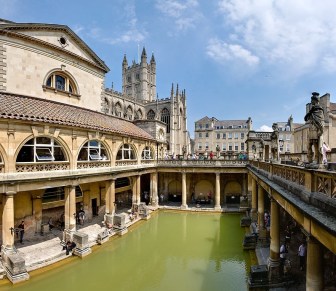
bathengland

Asclepeion in Bath, England

Ancient Greeks and Romans constructed “asclepeions,” healing temples that contained ritual baths which were dedicated to Asclepius, the Greek God of medicine. People would flock to these temples for both physical and spiritual healing. Asclepeions were typically built over or near water sources such as underground springs. The cult of Asclepius became very popular from the fifth century BCE onward.

It is possible that Bethesda was the site of an asclepeion. According to Urban C. von Wahlde’s “The Puzzling Pool of Bethesda,” Biblical Archaeology Review, September/October 2011, “This story about Jesus’ miracle suggests a long history of healing at the site. Roman medicinal baths constructed at the Bethesda Pool only a century or two later reflect this continued tradition. When Christians controlled Jerusalem in the Byzantine and Crusader periods, they liked to mark the sites of Jesus’ miracles and other important events in his life, so they added a chapel and churches that now cover the Bethesda Pool complex.”

So it would appear that the Pool of Bethesda did a magical dance starting as a Pagan holy site that morphed into a Jewish holy site. Then it went back to being a Pagan site after the destruction of Jerusalem in 70 CE until finally, a Christian church was built on top of it during the Byzantine era. There are two ways we can look at this. The first is that it’s a case of one religion trying to suppress another by “conquering” their sacred sites. There is an ugly truth to this practice that can be seen throughout history and it cannot be denied. However, the second way we can look at this is that sites such as the Pool of Bethesda [and the Brigid well in Kildare] were places of spiritual and energetic power from the get go. Pagans recognized this first but then others claimed these sites later and added their own intention and energy to them. One of my favorite places on earth where this is also the case is the Temple Mount in Jerusalem, especially the Western Wall. This is also an early Pagan site that was claimed later by Jews and now the Muslims. The energy I felt there is off the charts and I believe this is due to the countless millions of pilgrims who have come to this site to pray and to worship.

The reason why I bring this subject up is that instead of focusing on conquering and suppressing one another’s spiritual paths, perhaps we can learn to appreciate what we have in common. There are some places on our planet we all recognize as “holy” or “spiritual” and can tap into the energy there. Maybe this can be one of the ties that binds us together instead of pulling us apart.

Copyright ©2016 by David Taliesin, http://www.sabbatsandsabbaths.com

Posted in Jesus, Magic | Tagged , , , | Leave a comment

Meditation Exercise: Breath Prayer

meditation_sun

1.  Close your eyes. Sit still and upright, relaxed and alert

2.  Focus on your breathing. With each exhale let your body relax more deeply.

3.  When you are ready, begin to repeat a phrase in your mind with every exhale you take. Try to focus on the phrase, allowing all other thoughts to float gently by without dwelling on them.

4.  The phrase you choose should be 6-8 syllables in length. It should tie into something you’re dealing with in life and reflects a genuinely felt need you are experiencing at this present time.

Ex.  “Lead me through this maze, O God”  “Brigid lead me into health”

Pray it from whatever religious path you follow. The mantra should be spoken from the heart and be repeated for at least a week.

Copyright ©2016 by David Taliesin, http://www.sabbatsandsabbaths.com

Posted in Meditation, Prayer, Spirituality | Tagged , , , , , | Leave a comment

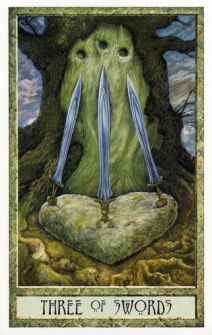
Three of Swords: Beyond Heartache

A new heart I will give you, and a new spirit I will put within you; and I will remove from your body the heart of stone and give you a heart of flesh. I will put my spirit within you, and make you follow my statutes and be careful to observe my ordinances. [Ezekiel 36:26-27, NRSV]

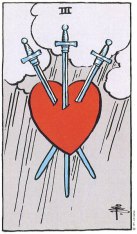
RW swords03

Rider Waite Tarot

The Three of Swords is one of the easiest cards to interpret and the hardest to receive. In the Rider-Waite deck, three swords piercing a heart with storm clouds and rain behind it mean the querent is in for story weather. Traditionally, this card is symbolic of heartache and is usually seen as an omen of bad things to come. A week ago I drew this card in my Celtic Cross spread in the House/Self position. I have been wrestling with what this means to me ever since. As the days progressed I received several pieces of bad news from close family members that have made my heart sad, but the image of the card stuck with me and so I wanted to see if I could derive a deeper meaning from it than simple heartache.

DC swords03

Druidcraft Tarot


The version of this card that opened up new possibilities of interpretation for me was the Druidcraft deck which has a stone heart with three swords pointing upward from and leaning on a tree whose bark has been peeled away and has been pierced by three holes. The imagery on this card seemed different from the traditional Rider-Waite version so I did a little digging and here is what I found.

The three diverging swords on the card are the three rays of Awen, a modern Druidic symbol. This Gaelic word means “inspiration” or “essence” and refers to poetic inspiration (traditional) and spiritual illumination (modern). This symbol has many beautiful meanings but the one that was of interest to me is as a symbol of the wisdom that comes from suffering. Therefore, this card has the potential of being a card of transformation instead of an omen of bad news and suffering. Depending upon what position the card turns up in, the Three of Swords could be calling us to learn from our broken hearts and use this wisdom as we move forward in life. This is especially true if it turns up in a past position in any given spread.

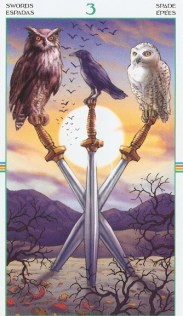
swords03

Wheel of the Year Tarot


The final version of the Three of Swords that really blew me away is from the Wheel of the Year Tarot. The swords are crossed and are stuck into thorny, dry ground. However, two owls and a raven sit on top of these swords and the sun shines behind them. Again, this holds the promise of transformation and wisdom that comes from suffering. Owls have universally been symbolic of wisdom and the raven is a bringer of magic in Wiccan and Native American spiritualities. The Sun is symbolic of the male energy of the Divine Presence. Therefore, the Three of Swords might be telling us that we are being guided through our journey of heartache and suffering by Divine hands who will use this experience for good in the end.

This is how the Three of Swords speaks to me. What do you hear it saying to you?

Copyright ©2016 by David Taliesin, http://www.sabbatsandsabbaths.com

Posted in Tarot | Tagged , , , | 4 Comments

Rising Appalachia – Medicine

As one who works with the energies and medicinal properties of plants and minerals, I LOVE this song and the vibe of this band. (Plus I live in Appalachia so how can I not love the band’s name?) Check it out!

Posted in Herbology, Magic | Leave a comment

10 Magickal Uses for Sage

Nice article on the uses of sage. It’s on my list to plant in my garden this year. –David Taliesin

1.  There’s more than one way to smudge.  By far, the most common ritual use for sage is in smudge bundles, usually by lighting the tip and burning them during cleansing.  But if you are smok…

Source: 10 Magickal Uses for Sage

Posted in Uncategorized | Leave a comment